Grace #4 … beautiful in black and white. This was supposed to be a fashion shoot, but I can never pass up an opportunity for a portrait shot!

Grace #4 … beautiful in black and white. This was supposed to be a fashion shoot, but I can never pass up an opportunity for a portrait shot!
Grace #3 … have I mentioned that I love shooting in a studio?

Grace #2 … another portrait/fashion shot from my developing portfolio.
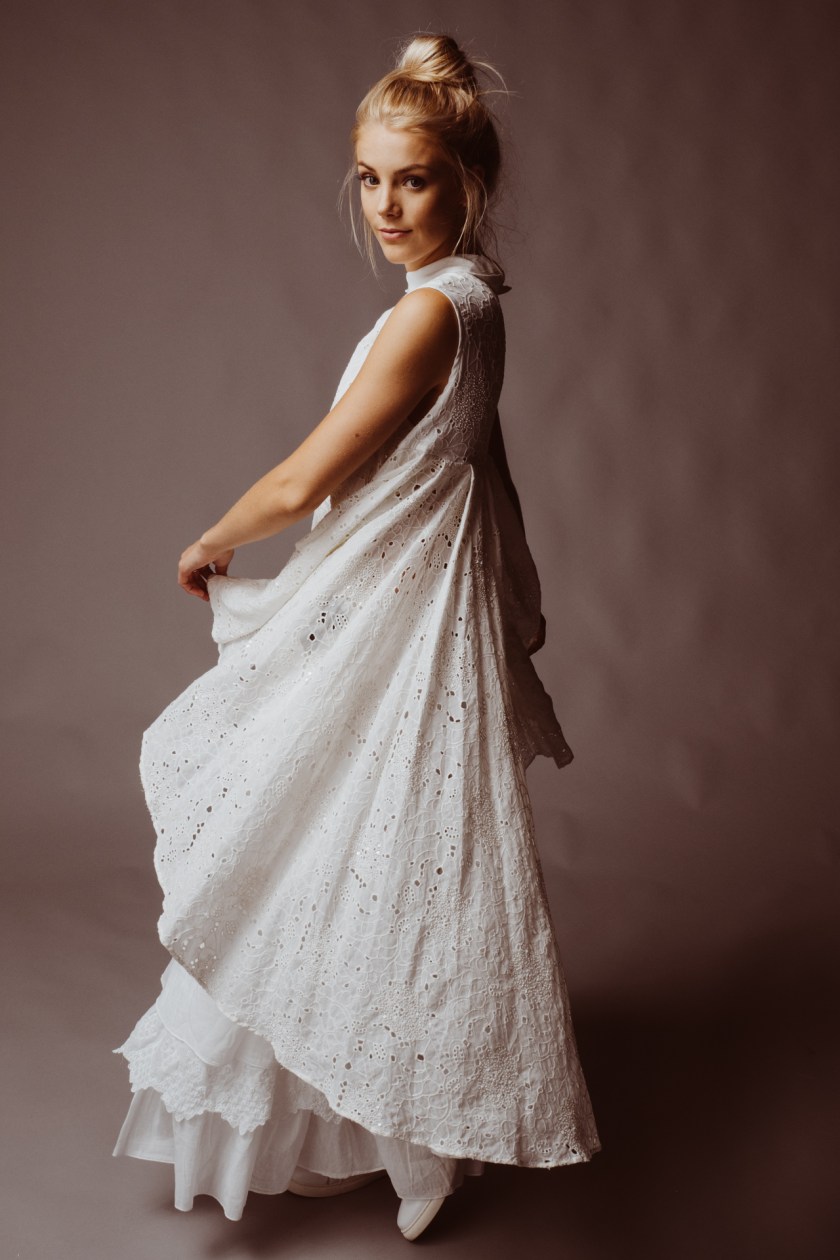
I attended a photography workshop on the weekend – a ‘build your portfolio’ workshop. There were models and sets and lights and action. It was fabulous. I felt that I’d found my new home!
Over the next week I’m going to feature some of the (many) images I captured from the weekend. The first image is of Grace …

I haven’t taught pre-service teachers for what seems like a long time … and out of the blue, a former colleague rings and asks if I want to teach a unit on engagement! Yay. The next week I start teaching. One student writes in his introduction: ‘Sharon, you were the most respected and most feared lecturer we had. It is poetically fitting that you are teaching me in my final year, as you also taught me in my first year.’
I had recognised this student’s name as soon as I saw it. As all teachers know, some students make an immediate impression on you. When the students are young, it’s often the students who challenge you the most that make the most impression – those students who don’t sit still, who don’t comply quickly, who ask lots of (what appear to be irrelevant) questions … the students school isn’t designed for. They remain with you for many years, and even ten years later you talk about them fondly (or with residual despair).
When the students are older the ones who make an impression are those who ask lots of questions, who bring a different perspective to class discussions, who don’t sit still in their thinking; the ones who develop tremendous resilience and now call themselves ‘teacher’ effortlessly, when initially that word reached their lips with great reluctance and unease.
A little over ten years ago I walked into the Week 1 tutorial and asked the students why they chose to study teaching. One student, a slightly chubby redhead, said that she’d wanted to be a paramedic. ‘Why didn’t you do that then?’ I asked, somewhat bluntly. Some weeks later I noticed she wasn’t in the lecture. The next week I ‘marched’ (according to her) her to my office to talk to her about the importance of regular attendance. (When you have potential, it’s a shame to waste it.) I taught her again in 3rd year, and then again in 4th year where her response to a literacy paper I had asked students to write was outstanding.
But even though students make an impression on you, at the time you’re teaching them, you don’t expect to end up lying on the grass under an umbrella listening to Ben Abraham and Archie Roach (as warm-up acts for Missy Higgins) on a hot summer’s afternoon in late January with them. Unless they’re Alison, the former slightly chubby redhead, who had come to stay for the weekend.
And then the next day, Alison asks me if I can take her photo.

Wouldn’t that be a great project … to return to all the memorable students I’ve taught and do a photography shoot with them! Who’s up for it?
Minimalist Friday. It’s the end of the work week for me – well, that’s not actually true now that I think about it. I’ve just started teaching at UTAS again (great big YAY going on inside my head right now) – just one online unit, let’s not get too excited (although I really am) – and as anyone who has taught or studied online knows, there really aren’t any days off.
So I’ll start again … Minimalist Friday. It’s the end of the week and this is what I’m looking forward to over the weekend. Minimalism. A line here, a shadow there … that will be enough for me.

A return to a flower today. I was looking through my photos this afternoon and came across a series of photos I did a month or two ago that I didn’t like at all. But on looking at them again I have changed my mind. They’re okay-ish.
Here’s one example … I was trying to represent a flower from a different perspective – to tell a different story from the usual front-on shot with the whole flower in the frame. To me this shot is an explosion of colour and line and shape. What do you see?

In 1999, I became a grandmother for the first time. I can’t quite believe that it’s 18 years ago, but apparently it’s true. Phil, my eldest grandson, turned 18 yesterday.
I remember when he was a tiny baby, I’d finish work and head round to give him a bath and a cuddle. Now he’s taller than me, his voice is deep and he speaks in one or two word sentences in that way many boys of that age do.
Here we are at my daughter Rochelle’s wedding in late December.

One of the (many) things I love about Tim is the way he supports me in my photography hobby. He doesn’t only model for me, or provide me with lens and camera combinations that create beautiful images, but he also provides opportunities for me to learn more about photography. We went to Sydney a few weeks ago so that I could attend a workshop on portrait photography. It was fabulous because a whole lot of technical things clicked for me, allowing me to take more control of what I’m doing behind the camera.

I don’t know if my developing skills are apparent to anyone else but me, but I’m now taking images where I control all the really important elements – and by that I mean the light.
Here’s a shot from an impromptu shoot this morning where I was testing a different lens/camera combination than my usual set-up. This was taken using a 42.5mm lens (full-frame equivalent = 85mm), at f1.2. It’s a beautiful lens – look what it does to the background: it gives a gorgeous bokeh* and beautiful separation of subject (Tim, in this case) and background.
The bokeh forces the viewer to focus on the subject and thus its appeal in photography. If all of the greenery had been in focus, the image would have been very busy and the background would have been competing for attention.
Thanks Tim for being a model and especially for being the means of me continuing to learn about photography.
*Bokeh – a Japanese word meaning ‘blur’.
Another shot from the William Ricketts Sanctuary in the Dandenong Ranges. Between 1949 and 1960 Ricketts (1898-1993) travelled to Central Australia and lived with the Pitjantjatjara and Arrernte Aboriginal people. He also spent two years in India (1970-1972) living in an ashram learning about the philosophy of Indian people.
The traditions and culture he experienced in Central Australia inspired many of his sculptures. This is one work that shows that influence very clearly.
While the cracks in the sculpture weren’t deliberate, they help to convey a message about the fragility of life and culture and tradition.

 Musings from the cold