Posted in Life, Writing

Forgiving Light

Eleanor lifts her camera just as the woman raises her head. Her face is streaked with tears, the light catching them, so it seems they shimmer rather than fall.

She quickly takes in a half-finished coffee, scarf draped over the back of the chair, and a book open on the table. Something in the woman’s stillness suggests she hasn’t turned the page in a while.

Her finger hovers over the shutter button. The woman meets her eyes; a fragile thread of connection stretches between them.

Eleanor’s mind, unhelpfully, begins to invent possible stories about the woman. Grieving, she thinks. Recently divorced. Terminally ill. Bereaved daughter. Job loss. A pigeon-related incident. Endless possibilities spinning through her mind like a carousel.

She could walk away, let the woman have her sadness in peace, but something in the woman’s faint smile sees Eleanor push the door open and step inside.

The bell gives its half-hearted ting. ‘Just the usual, thanks Matt,’ she calls. ‘Oh, and one of your Portuguese tarts.’ She turns toward the woman. ‘Would you like one as well? They’re dangerously good.’

The woman shakes her head, then mid-shake says, ‘Yes, why not.’

Eleanor smiles. ‘Excellent decision.’

‘Is it all right if I sit here?’ she asks, pointing to the table next to where the woman is sitting. ‘I promise not to talk unless it seems vital.’

‘That sounds perfect,’ the woman says, wiping her face. Eleanor, pretending not to notice, stirs her coffee as though it requires medical precision.

They sit in silence. Eleanor wrestles with the tart’s flaky pastry and warm, wobbly custard, while across from her the woman breaks hers cleanly, long fingers steady and assured. Eleanor’s own fingers feel clumsy – her sister once called them ‘sausage rolls,’ and she has to admit the description isn’t entirely unfair.

She guesses the woman is in her late thirties, graceful in that effortless way some younger women are. “Well put-together,” Eleanor’s mother would say, “considered”.

‘When I first saw you,’ Eleanor breaks the silence, ‘my imagination went into overdrive. I kept inventing reasons for the tears. Little scenarios, death, divorce, job.’

The woman glances at her, curious. ‘None of the above,’ she smiles, licking crumbs from her fingers.

‘You’re a photographer?’ she asks, nodding at the camera on the table.

‘Sometimes. Depends who you ask. My grandson says I’m a breakfast-face photographer.’

The woman laughs. ‘Breakfast-face?’

‘Yes. He thinks he’s my muse. I take photos of him eating breakfast.’ Eleanor chuckles, shaking her head. ‘Don’t ask.’

‘Can I see?’

Eleanor flicks through the images on the camera until she finds yesterday’s – Garry mid-spoon, mouth wide, eyes half closed. The light falling on him like a benediction.

‘He’s wonderful,’ the woman says. ‘And clearly plotting something.’

‘Always,’ Eleanor says. ‘It keeps the mornings interesting.’

The woman traces a fingertip along her cup. ‘You took my photo earlier,’ she says, not accusingly, just a fact laid gently on the table.

Eleanor blushes. ‘I did. I’m sorry – it was the light. It does that to me sometimes.’

‘Can I see?’

Eleanor turns the screen toward her. The woman’s face is luminous against the dark interior, the tears faintly catching the light.

The woman studies it for a long moment. ‘You’ve made me look… beautiful. Not sad at all, even with those tears.’

‘You are beautiful,’ Eleanor says simply, then wonders if that’s too much. ‘It’s mostly the light,’ she adds, flustered. ‘It’s very forgiving this time of day. Like a kindly aunt.’

That earns another laugh.

‘I wasn’t sad, you know,’ the woman says finally. She closes the book, letting Eleanor see the cover. A Monster Calls by Patrick Ness. ‘It just caught me off-guard. That ending.’

‘So,’ Eleanor says lightly, ‘you were crying over fiction, not a break-up?’ She leans back slightly, watching the shift in the woman’s expression.

‘Mortifying, isn’t it?’

‘Not at all,’ Eleanor says. ‘I once wept in a tram over a poem about a cabbage. People gave me space, though, which was nice.’

The woman laughs, a bright, sudden sound that makes Eleanor laugh too. Matt glances over, shakes his head with a faint smile, and goes back to his orders.

When the laughter subsides, they sit smiling at each other, the moment oddly companionable.

‘Thank you,’ the woman says at last.

‘For what?’

‘For seeing me. Even if you got the story wrong.’

‘Oh, I usually do,’ Eleanor says. ‘But I enjoy the practice.’

The woman slips the book inside her bag and stands. ‘You should call that photo Forgiving Light.

‘I just might,’ Eleanor says.

When the door closes behind her, Eleanor’s eyes settle on the table where the woman was sitting.

She lifts her camera and frames the scene – the empty cup, the wrapper, a few stray bits of pastry scattered across the plate. Caught in a narrow shaft of fading golden light, the woman’s scarf draped over the chair.

She presses the shutter, then scoops up the scarf and rushes out after the woman.

Posted in Life, Photography

Faces of Breakfast

Eleanor is plagued by a dream of herself that she has not yet managed to actualise.

It visits her most mornings, while the kettle boils, the version of herself she keeps coming back to, the one who moves through the streets with a camera at the ready, collecting quiet moments. That woman is captivated by the way light touches faces and the stories a face tells. She lives in a house smelling faintly of cedar and tea, with shelves of photography books she browses intermittently. Her portraits don’t hang on her own walls, but they do hang on other people’s – portraits others have described as intimate and assured and quietly transcendant.

Eleanor, on the other hand, mostly photographs flowers these days though she’s not exactly sure why. She thinks it’s something to do with their fragility, their complexity – how each flower seems to have a personality of its own. Photographing them feels like a small experiment in seeing differently: shifting focus, playing with light, adjusting angles until some kind of story emerges. At home, she works deliberately, arranging light and background, the process almost meditative. In gardens, she responds to what’s there – wind, shadow, a sudden burst of colour. She’s exhibited her work a few times – small shows where people have bought pieces and said kind things – and members of her U3A photography group often tell her she has a real eye. She thanks them, smiles, but inside she thinks they’re just being kind … or polite … or wrong.

She finds, in a box of prints tucked under the bed, photographs she took six years ago while she was going through cancer treatment. That time still lives in her skin, the memory of so many hands touching her, adjusting her, ensuring her position is just right. It had made her uneasy, and that unease became the focus of a project – hands as both comfort and intrusion. In one image, Sonia, the model, stands in a shaft of late afternoon light, her body half-covered by her own hands, the gesture both protective and exposing. Eleanor studies the image for a long time – the narrow beam of light, the rawness in the posture, the quiet, potent vulnerability of it. This, she thinks, is the kind of work she wants to return to.

She reaches for the book of portraits she printed when she’d finished her Faces of Melbourne project and flicks through it. She remembers where each shot was taken, her subjects’ names, and the stories the older women told as she photographed them. She was deliberate about her practice – the light, the framing, the angle – she’d known what she was doing. Looking through those pages again, she feels the quiet certainty of that work, the joy it gave her, yet something in her still resists believing it was assured.

Eleanor hears the scrape of a chair behind her and looks up. Her grandson has wandered in from the garden, a piece of toast in one hand, his current favourite dinosaur in the other.

‘Who’s that?’ he asks, pointing to a photo in the open book.

‘That’s Josette,’ Eleanor says. ‘She was walking through Myer when I saw her.’

‘Did she tell you stories?’

‘She sure did,’ she says. ‘Stories about her son who grew up and got married – and she showed me pictures of him too.’

He studies the page, eyes wide. ‘Who’s that? I think she’s pretty.’

‘That’s Bella. Her name means beautiful. And that’s Brabh. He was my first face of Melbourne. I was standing at the traffic lights and I saw him across the road. His face was so interesting I just had to take his photo.’

He looks up at her. ‘You should take my photo too. Every morning when I come here. You could make a book about me – Garry’s Faces of Breakfast.’

She laughs, surprised by the small flicker of excitement that rises in her chest. ‘Maybe I could,’ she says.

At 7:10 the next morning, Garry arrives, sleep still in his eyes, hair sticking up, a dinosaur in each hand. She gets him a bowl of Coco Pops and sits with him at the table. The light from the window falls across his face. Eleanor lifts her camera, adjusts the focus, and presses the shutter.

The image on the camera screen is a little soft, a little crooked. His spoon is halfway to his mouth, milk dripping onto the table.

She makes tea, sits across from him, and listens to a story about a dinosaur that can fly and also do karate. She nods solemnly. “Sounds plausible.”

Later, she opens her laptop and creates a folder: Breakfasts with Garry. She’ll add one photo a day until he gets bored, or until she does.

While she doesn’t feel actualised … or even assured … she does feel like someone who knows how to begin.

And that, frankly, is more than she expected.


I have used the same first line as my previous story While the kettle boils. I wanted to see if I could take it in a different direction.

Posted in Flowers, Photography

Photos from the week

Most of my photos this week are of flowers. I’ve been photographing flowers since I was first given a digital camera for Christmas in 2007. Until this very moment, I’ve never stopped to think about why. What drew me to flowers in the first place? What keeps drawing me back?

I tend to photograph single flowers – one type rather than bouquets. Have you noticed that? More often than not, it’s one bloom, or several of the same kind. That’s something I’ve never really thought about either.

So I just set myself a small thinking challenge: why do I love to photograph flowers?

Partly it’s their fragility, and also their complexity, their personality, and their vibrancy, allowing for endless possibilities.

Partly it’s the challenge they offer. How can I be intentional with something so fragile and complex? What am I trying to say when I photograph this flower, this time?

Each photo becomes an experiment in seeing differently. How can I play with light, location, composition, depth of field? What happens if I shift my focus – literally or figuratively?

And flowers are everywhere, especially at this time of year. They don’t need bookings or studios or expensive gear. They don’t require complicated set-ups, though there’s no shortage of creative problem-solving along the way. Do I show the vase, and if so, how much of it? How close/far-away from the lens do I want the flowers to be? Do I want all of the flower lit or will there be shadows – and if so, which bits will be in shadow? Which parts do I want in focus – the middle, the edges of the petals, all of it? Do I want them to bend in a particular way? How will I hold them still/in position?

So many decisions!

Photographing flowers gives me space to develop technically and creatively. It’s a way to find my sense of what feels like me. I love the clean precision of a focus-stacked image where every petal is sharp – well, I do when other people create those sorts of images – but I also love the dreamy, soft-edged, not everything’s in focus look.

I’ve also noticed that the flowers I photograph at home have a different intentionality, process, and style than the flowers I shoot in a garden. At home, I can control light, composition, and background – it’s quieter, more deliberate, almost meditative. In a garden, there’s a sense of discovery and spontaneity: the light changes constantly, a breeze spings up just as I press the shutter button, I’m always tucking other plants/leaves/buds out of the way. The process is more about responding than arranging. They each have their own rhythm, and their own way of reflecting how I see the world.

Anyway, here are some of my flower photos from this week.


Tulips (Forest Glade Garden, Mt Macedon)


Daffodils (Forest Glade)


Getting up close (Forest Glade)


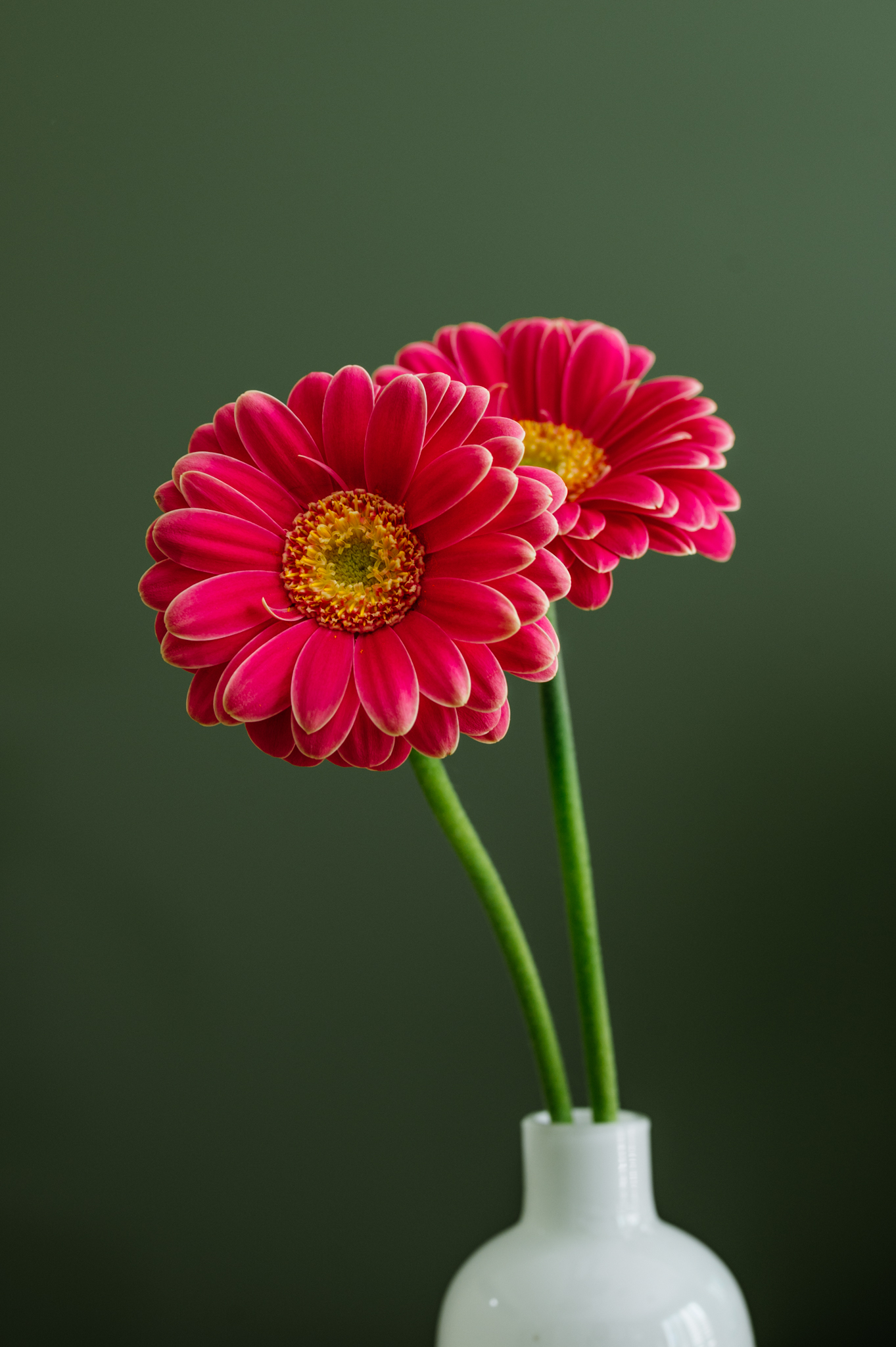
Mini gerberas at home

Posted in Flowers, Photography, Writing

On recognising your style

When I was first given a camera, sometime around 2007, I had no idea how it worked or what I would photograph. But I did know something about light from my time at university and so I experimented. A halogen lamp. An oven tray wrapped in aluminium foil. Windows with lace curtains. I bought flowers from the local florist – single stems arranged in whatever came to hand (a vase, a jar, a glass) – and set them up in areas of the lounge room. And then I played with the light … and learnt how to use the camera.

One wall of the lounge room was painted green, and it became my backdrop. The flowers stood out against it, classical and beautiful. I started to take the camera further afield – to the botanical gardens in Hobart, City Park in Launceston, the rhododendron gardens in Burnie. I photographed red hot pokers and made them redder, the daffodils that popped up unexpectedly under the rose bush in the backyard, and the insides of camellias.

Over time, I started photographing people – people I passed in the Bourke Street mall, those lingering near the steps of H&M listening to the buskers, those waiting at the lights on King Street, or outside Flinders St station. Sometimes I asked permission, sometimes I simply asked by lifting my camera, but always there was a burst of courage required in the approach. Most said yes. Some said no. I learned not to take refusals personally. And not to ask women of a particular age – they always said no. I loved the small exchanges: the older women who wanted to chat, the stories shared in passing, the faces that lingered in my memory – Jiggy, Brabh, Junior, Lisa, Samyrah, Belle, George. I gathered these portraits into a book, Faces of Melbourne – and printed one copy only. It’s one of my favourites.

My practice developed. I hired studios, booked models, attended workshops. I learned posing mostly from the models themselves, and more about lighting from every shoot – how to use a beauty dish, umbrella, softbox, and how to make the most of window light. As the gear expanded so did my knowledge. I’d moved a long way from the days of the halogen lamp and the oven tray wrapped in foil.

One house we lived in had a white brick wall to use as a backdrop, two storeys high and east-facing. It was a space filled with light, and the tulips, hydrangeas, sunflowers, and poppies looked luminous against it.

Then life got in the way …

Eventually, another move, another house. I had a ‘studio’ in this new house, and I painted the walls a neutral colour to use as a backdrop. I kept out some of the lighting gear, thinking I’d get around to using it. But two years passed with only a handful of photographs, none of which excited me. They were just the same, but worse technically. I set up the lights, but couldn’t create anything new. Photography no longer satisfied me in the way it had and I began to wonder if I had anything left to say.

I thought the issue might have been one of space and explored the idea of building a studio in the backyard. But in a moment of clarity, I realised that I hadn’t learnt to use the light in this new house. Shortly after, at a photography workshop in Ballarat, Kris, the facilitator, spoke about recognising your own style – how good it was when someone recognises one of your images as yours because it has a certain style. That struck me and the two ideas became a spark.

I looked around the house again – so many windows, so much light. Different walls, each with its own character/colour/shadows. I realised that what I’d thought was sameness was actually my style, something I’d been building since 2007.

I felt excited again. I made so many different choices, and remembered what a photography teacher had once told me: photography is problem-solving. Given all the problems I was solving (how to hold the reflector in just the right position, how much to open or close the shutters, what to hold the flower with, how close or far away from the background to put the flower), I felt the truth of it. I also knew that the solutions could be simple: a halogen lamp and an oven tray wrapped in foil, a window and a square of black card, a green wall and shutters to shape the light.

And so each morning I reach for my camera and some flowers, and go in search of the light. I fall into a rhythm – one which absorbs and excites me. I feels my style re-emerging, and with it, the outline of a new self.

An early image (circa 2007)

The white wall as backdrop


Street portraits


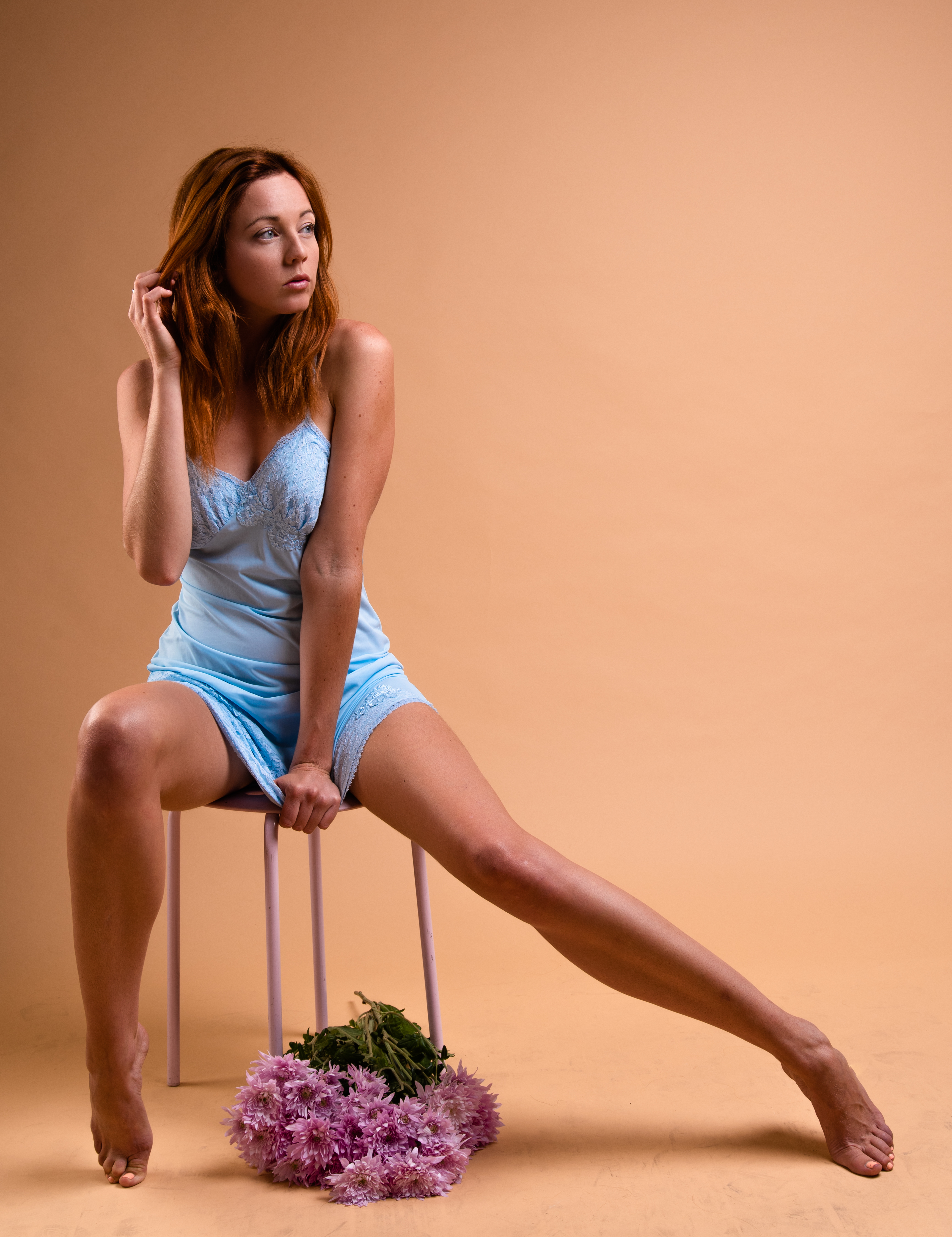
Working with models


Finding the light – September 2025

Posted in Life, Photography, Writing

The art of letting go

She sets up carefully: a sheet of black card for the backdrop, the shutters angled to shape the light, the plamp ready to hold the anthurium steady or pull leaves out of the frame. She likes to get the shot right in camera so thinks about the composition, what’s in and what’s out, where the focus hits, how the light falls.

And yet, in this meticulously constructed scene, the unexpected happens. A petal drops. A cloud crosses the sun. The reflector topples just as the light was perfect.

She clicks anyway. The flower leans awkwardly, the shadows fall in unexpected ways, the vase looks crooked. The image isn’t like the one she imagined, but it carries something she hadn’t planned for.

Photography, she remembers, isn’t only about getting it right in camera. It’s also about letting go – allowing the scene, the light, and the unexpected to have a say … the blur, the shadow, the crooked vase.

When she clicks the shutter again, she does so with curiosity. The image is imperfect, but it has something the more carefully crafted ones don’t – a sliver of truth.

A gentle reminder that sometimes more interesting things happen when you let go.

And then she opens the files on her computer. Out of focus, shadowy, crooked. She sighs. All very well to wax lyrical about imperfection, she thinks, but she still doesn’t like them.

Not yet, anyway.

Posted in Life, Photography, Writing

The art of looking away

There’s a cat on her windowsill. The black one from next door, red bandana tied rakishly around its neck, a burst of insouciance.

He watches her, looking like he knows things she doesn’t.

She watches him back then lifts the camera and looks away.

In photography, negative space is the area around the subject, the quiet, unclaimed part of the frame. She looks there instead of at the cat. At the branches giving him an absurd hat. At the fence palings rearing from his head. At the shadows, menacing, behind him. She makes a choice about where to put her attention.

Then is drawn back to her phone by the vibration, and spins through war, famine, scandal, disaster. She scrolls, for far too long, then finally looks away.

She looks away and in doing so notices the tiny bits of life that belong only here, at this moment in time. The sunlight sliding through the shutters like it has somewhere else to be, the Vegemite-coated knife balancing on the sink as if auditioning for the circus, the leaf skittering erractically down the path to come to rest on the mat at the back door, the cat still watching from the windowsill.

She lifts her camera again, capturing it mid-stretch, and realises – again – that the art of looking away is also the art of looking at.

Posted in Life, Writing

What she doesn’t photograph

She photographs because she wants to hold still what is fleeting – an angle, a pose, an age, a smile, a moment in time – before it dissolves, fades, evaporates into reality.

But what she doesn’t photograph matters too.

She didn’t photograph the sky turning red from a hundred bushfires, or the water lapping at the laundry door. She didn’t photograph the washing line, snaking down the backyard, heavy under the weight of the weekly wash, or the heat from the wood stove in the kitchen. She didn’t photograph the hospital bracelet crumpled in the bottom of the bag, or the small fist clutching a handful of her mother’s hair.

She didn’t photograph the look exchanged before the first word of bad news, or the sigh that followed.

She didn’t photograph the relief in the hospital corridor after the surgeon said it went well, the ordinary dinners that kept them alive through ‘that’ time, the thousand mornings where nothing “happened” except that she woke up, or her fumbling attempts at dancing that looked more like jelly caught on a string.

Sometimes she wants proof that it really happened the way she thinks it did. That the sky really was pea soup green, that the drummer really did smile at her.

Maybe it’s better this way. No evidence, no proof. A series of memories, more absurd and exaggerated each time she recalls them – never sure which details are real and which are imagined.

Or which she simply longs for.

Posted in Life, Mid-life blogger, Photography, Writing

Feeling Friday

Yes folks, it’s time for another Friday post. I feel that the Fridays are rushing by so quickly that it’ll be Christmas before I’m ready. Again. Is anyone ever ready for Christmas? There’s a tangential path I do not want to go down, so let’s head to our regular three Friday questions and an F-word.

Facadism.

Yep, that’s my F-word for this week. Read on to find out what it means, or look it up in a dictionary to avoid the scrolling if you choose. If you do look it up in the dictionary, however, you won’t get to hear/read what it means to me.

The three regular questions that I respond to each Friday (since September 6 – yes, it’s been that long) are:

  1. What made me happy this week?
  2. What did I enjoy on social media this week?
  3. What did I work on this week?

I’m going to do my best to keep it brief today. Let’s see how I go with that!

  1. What made me happy this week?
    Warm days. We had some days through the week where the temperature was around 25C. It was blissful. I wore sandals to work! I know. And my feet weren’t even cold. I can feel pool weather coming on. Yay!

  2. What did I enjoy on social media this week?
    I have come across Dustin Poynter on Instagram. He’s ‘the flag guy’. He finds others’ reels where they’ve been behaving poorly or well and runs across a field with either a red flag or a green one. It’s interesting to get an insight into the way (mostly) men treat their partners and there’s some really lovely green flag moments (and some quite horrifying red flag ones). If only we could all be green flag people.

    3. What did I work on this week?
    I’ve been co-writing a literature review on co-design in Aboriginal and Torres Strait Islander child and maternal healthcare with my boss, Kerry, this week. It’s led to some really interesting conversations which I’ve thoroughly enjoyed. I have also enjoyed the process of re-structuring (I think just about every paragraph was the first one at one point), re-writing, reviewing, and editing. I even, weirdly, enjoyed putting the glossary in alphabetical order (thanks for the help Alison and Tim), and adding the full-stops and commas to all the right places in the reference list. It was very satisfying work!

Now to my F-word for the week: facadism.

I hadn’t heard of it either till I read something online. Okay, you got me. It was a list of words starting with F, but there are some very interesting F-words to be found! Many more than my limited vocabularly allows for.

The reason I chose facadism, which means the principle or practice of preserving the fronts of buildings that have elegant architectural designs (source: https://www.dictionary.com/browse/facadism) is because Tim is doing a photography project on motels and hotels in regional Victoria.

We went for a long drive on Sunday and came across some interesting towns we’d never heard of, and in those interesting towns were interesting buildings. Tim took some really lovely photos of them.

None of them suffered from facadism. These were original old buildings with no new building growing behind their original facades. Wouldn’t it look awful if this had a highrise building protuding from the roof?

Two-storey hotel with wrought iron around the top balcony.
The Botanical Hotel in St Arnaud. Built in 1905.

My photo makes it look like it’s on a bit of a lean, but I can assure you, it’s properly upright.

So there you have it, a new word (for me at least) and an invigorated desire to visit more regional towns we previously hadn’t heard of to take more photos of buildings that do not suffer from facadism.

See you next week.

Posted in Family, Life, Melbourne, Mid-life blogger, Photography

Far out, it’s Friday!

Fridays seem to come around much more quickly since I’ve started blogging regularly.

It’s time for another three questions and an F-word.

This week’s F-word is fragility, but before I get to that, I’ll respond to the three regular questions.

  1. What made me happy this week?
  2. What was I most proud of this week?
  3. How did it feel to see a particular something in real life for the first time?

I’m going to answer all three questions at the same time, because they all have the same answer.

This. This is what made me happy this week. The publication of this book.

It won’t come as any surprise to those who read this blog on a regular or semi-regular basis to know that I’ve been excited for some time to see this book in real life.

Well, last night I got the opportunity to do just that. Last night, October 3, 2024, the book was launched by the Royal Historical Society of Victoria. It was a packed house – standing room only – with loads of people eager to view and buy the book.

In case you don’t know, the story of my (very minor) involvement goes like this:

I was retired briefly in 2022 and part of 2023 and decided to join U3A (University of the Third Age). I joined two groups – a photography group with U3A Hawthorn, and a book club with U3A Deepdene. Both were interesting and educational and great for meeting new people and hearing new ideas and perspectives.

The U3A Hawthorn group were invited by Richard Broome, president of the RHSV, to contribute images of Melbourne’s lanes to the society primarily for the purpose of creating a second edition of Weston Bates’s book published in 1994, titled Essential but unplanned: The story of Melbourne’s lanes. Sixteen members of the group eagerly scoured the city’s laneways looking for just the right angle and light and spark of interest. All up, we produced 3000 images.

Of those 3000 images, one of mine was chosen to be on the front cover of the book.

  1. Seeing my photo on the cover made me very happy.
  2. I am super proud that one of my images was chosen to be on the cover.
  3. It feels great to be able to flick through the book, read about the fascinating history of Melbourne’s lanes, and see the fabulous images selected from the 3000 images that were contributed. The ones not used will be held by the RHSV in their collection to be used at any time someone is doing research on the city.

It was a great project to be involved with. It was also really great to catch up with others from U3A Hawthorn’s photography group.

And so to my F-word for the week: fragility

While I’ve been feeling happy and proud, there’s also been an undercurrent of deep sadness in our household this week. When a family member is desperately ill, you’re reminded of the fragility of life.

I’m not going to get deep and meaningful here or look for quotes on life’s fragility – but at the moment it’s looming large in my heart and that’s why it’s my F-word this week.

Posted in Food, Mid-life blogger, Photography

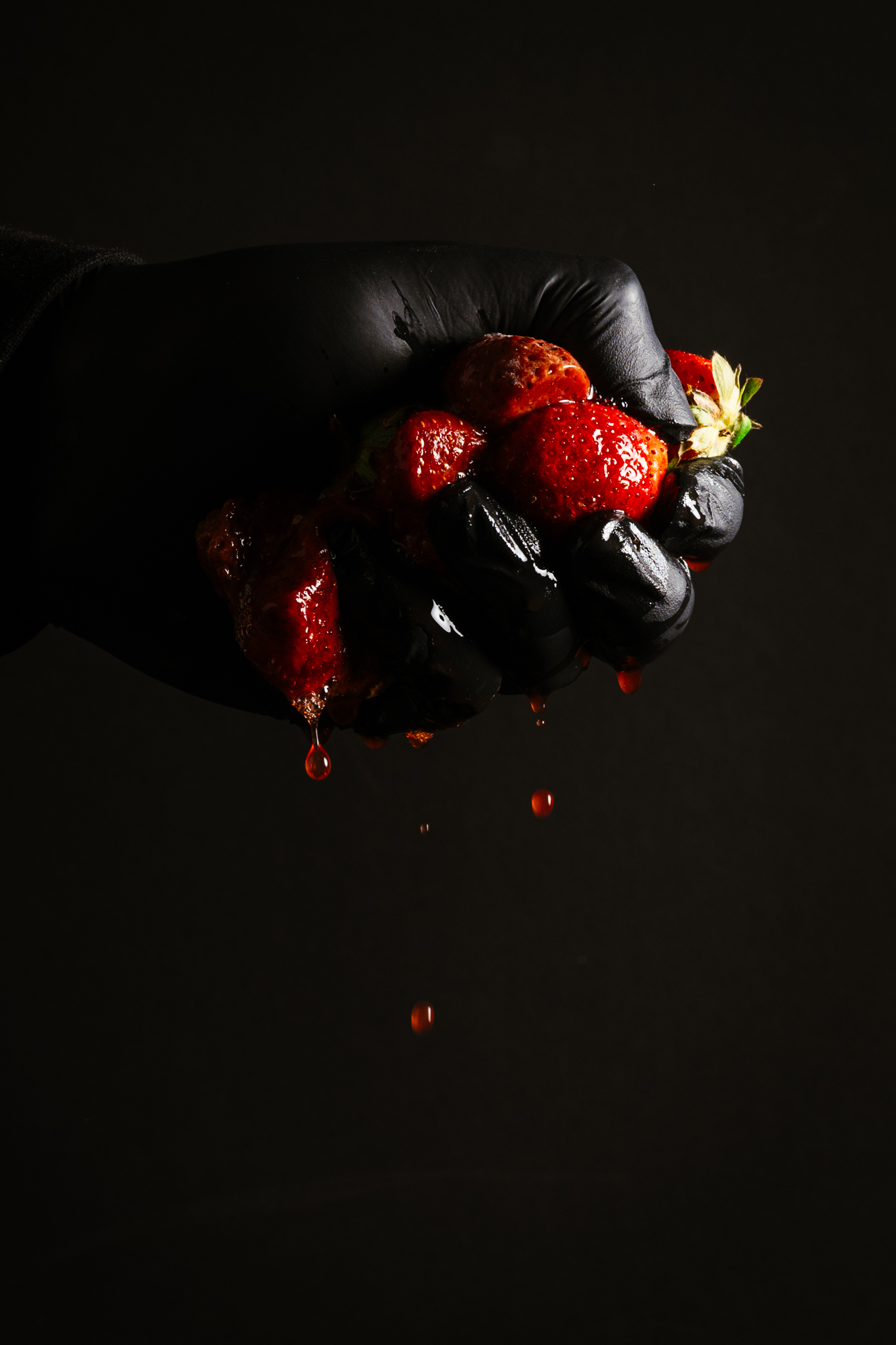
Intentional Photography: The Black Glove series

A few weeks ago, the word for our Word a Week photography challenge was orange. I had the idea of taking a photo of half an orange being squeezed to make orange juice.

We tried out a few shots, then Tim (who was doing the squeezing) asked: ‘how about I wear a black glove?’ and so the Black Glove series was born.

This morning was very wet and very windy, thus the perfect time to squeeze some more fruit. It’s a messy business, so we turned the garage into a makeshift studio.

I don’t know what I’m going to do with these images, apart from share them here, but that’s not really the point.

The point is, I really enjoy the process. There were aesthetic decisions to make: how to hold the fruit, where to put it in relation to the light, how much to squeeze, when not to, where to put the fruit in the frame; and then there were technical decisions: do I need the reflector? One light or two? Do I need to feather the light? Side lighting or front?

And that’s mostly what I enjoy about the process: being intentional.

Intentionality

When I did part of a photography course a number of years ago, one thing was emphasised over just about anything else: ‘intentionality’. Being intentional in photography is being deliberate about the decisions you make in relation to things like choice of subject, composition, lighting, equipment, post-processing.Now, I love wandering around, seeing something of interest, whipping my phone out and taking a photo of whatever’s captured my attention as much as the next person. But I really love being intentional.

I can remember when Tim first gave me a camera – I’d make all kinds of decisions I really didn’t know how to make – about lighting, composition, and what I wanted the image to look like – and over the years I think I became less intentional. It’s so easy, with the camera in your phone now (I first started taking photos with a camera before mobile phones had decent ones), to point it at something and click the shutter button.

But everytime I get into the studio (whether that’s a proper studio or the garage), I get to be intentional. I’m not just seeing something of interest – I’m creating something. For me, it’s the difference between taking the shot and making the shot. When I’m being intentional, I get to make something, and that brings enormous satisfaction.

A blog post on the fstoppers website, outlines the difference: “One is a passive approach meant to capture what occurs in front of the camera should something interesting cross its view, while the other is an active engagement in the creative process that draws on the technique, imagination, and foresight of the photographer“.

So, after a quick burst of intentional decisions – from choosing the fruit to squeezing it just right, adjusting the lighting, and framing each shot – here are the results.

All image ©Sharon Pittaway

Photography for me, especially when I’m intentional about it, gives me a great deal of satisfaction. These images aren’t only about fruit being squeezed; they’re about creativity and play.

I can be creative through playing: playing with the lights, playing with angles, framing the subject in different ways (low in the frame, or high) and playing through the post-production process. It’s no coincidence that the tagline of this blog is playing with ideas and images.

But of course, there’s more to images than taking them. There’s the viewer. How is a viewer going to respond? They don’t see the decisions, only the outcomes; they don’t know why I asked Tim to squeeze an orange in the first place, that he came up with the idea of putting on a glove (partly because he wasn’t enjoying the juice on his hands) and why I chose to shoot more fruit in the way I did today.

I won’t know your response, unless you tell me in the comments, but one person who saw the orange juice image recoiled at the “violence” in the shot. Another person who saw it said, “that’s the sexiest thing I’ve ever seen!”

Neither of those responses were anywhere near my thinking when I took the shots. As the photographer, I can make deliberate decisions about how to make the shot, but I’m not in any kind of control over how a viewer responds. And most of the time I never get to find out because people don’t generally comment or give any feedback.

What do you think? Leave a comment and let me know your response to these images. And/or tell me about your intentionality. What kinds of decisions do you make in your photography?

Thanks, as always, to Tim for being my willing accomplice.