Posted in Life, Mid-life blogger, Writing

Friday’s 3 questions and an F word

It’s Friday again. Not sure how that happened, but here we are.

Last week I wrote my first ever 3 questions and an F word post and because no one read it (apart from my sister) I thought I’d send another post into the void.

The premise is, that you respond to three questions and then choose a word beginning with F and write about that. The three questions are:

  1. What made you happy this week?
  2. What made you sad this week?
  3. What are your plans for the weekend? (I think. I can’t actually remember, so I made that up.)

What made me happy

Work. Yeah, I know, strange answer, but there you go.

I’ve been working on a project about perinatal mental health screening, specifically in Indigenous communities in Victoria. The Department of Health are updating the screening guidelines and basically wanted to know what would make the screening process more culturally safe. So they asked me to ask some midwives, maternal and child health nurses and others of that ilk, as well as Aboriginal parents how the screening process could be improved.

On Friday last week, I went to a playgroup to talk with some parents. One little fella, 14 months old, toddled up to me and put his head on my knee as I introduced the project to the mums. He then reached his arms up and so I picked him up for a lovely cuddle. He came back later for another one.

Now, I’m not a hugger but cuddling babies is a very different kettle of fish. I highly recommend it.

And then this week, I finished the report the Department said I had to write, because apparently, just talking to people wasn’t enough. I finished it – wait for it – one whole week early! Some big days of writing and editing, but the draft is in and now I’m waiting for the feedback.

So work was good this week.

What made me (really) sad

I was scrolling through Instagram last night and one of the posts I stopped to read made me really sad. Disturbed. Concerned for where we’re headed as a society.

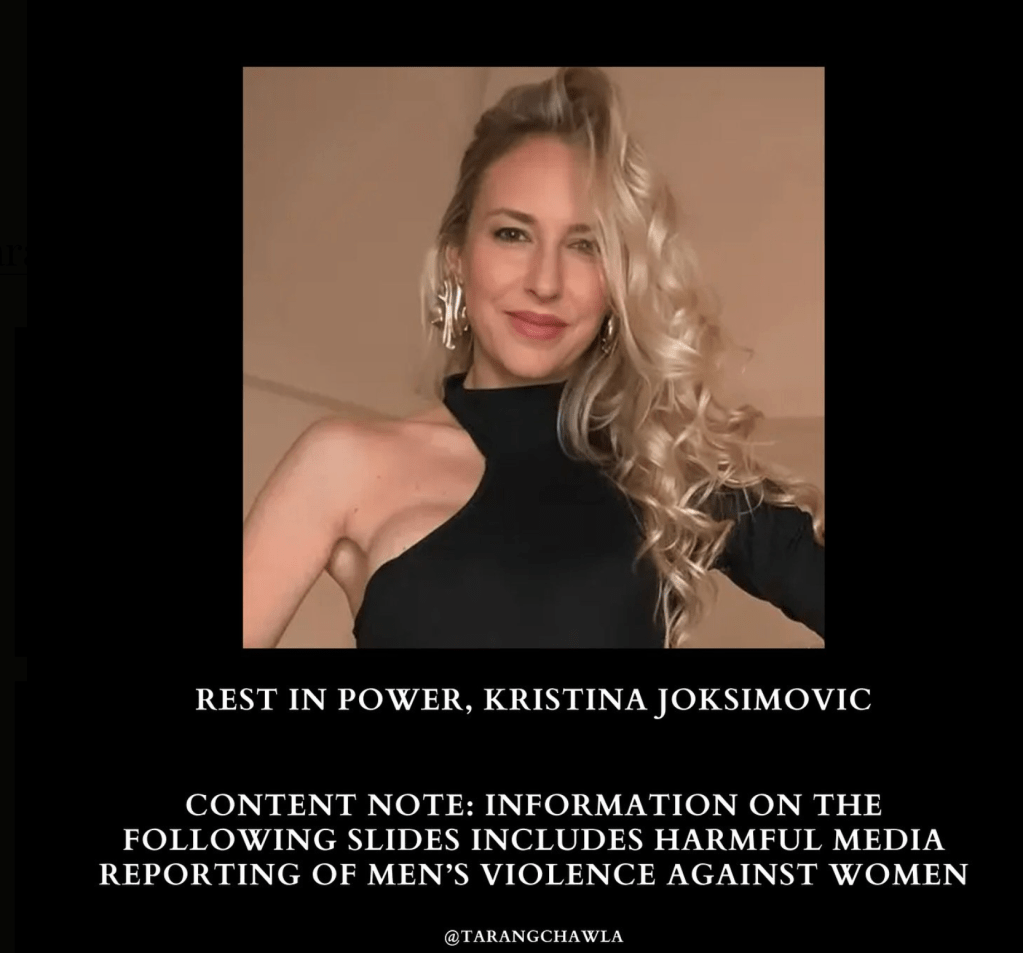
Tarang Chawla is a Melbourne man whose sister Nikita was murdered by her boyfriend in 2015. Tarang speaks out strongly about men’s violence towards women – you might have seen him on TV or follow him on Instagram like I do.

Last night as I was scrolling, I saw this post.
Source: Tarang Chawla’s post on Instagram

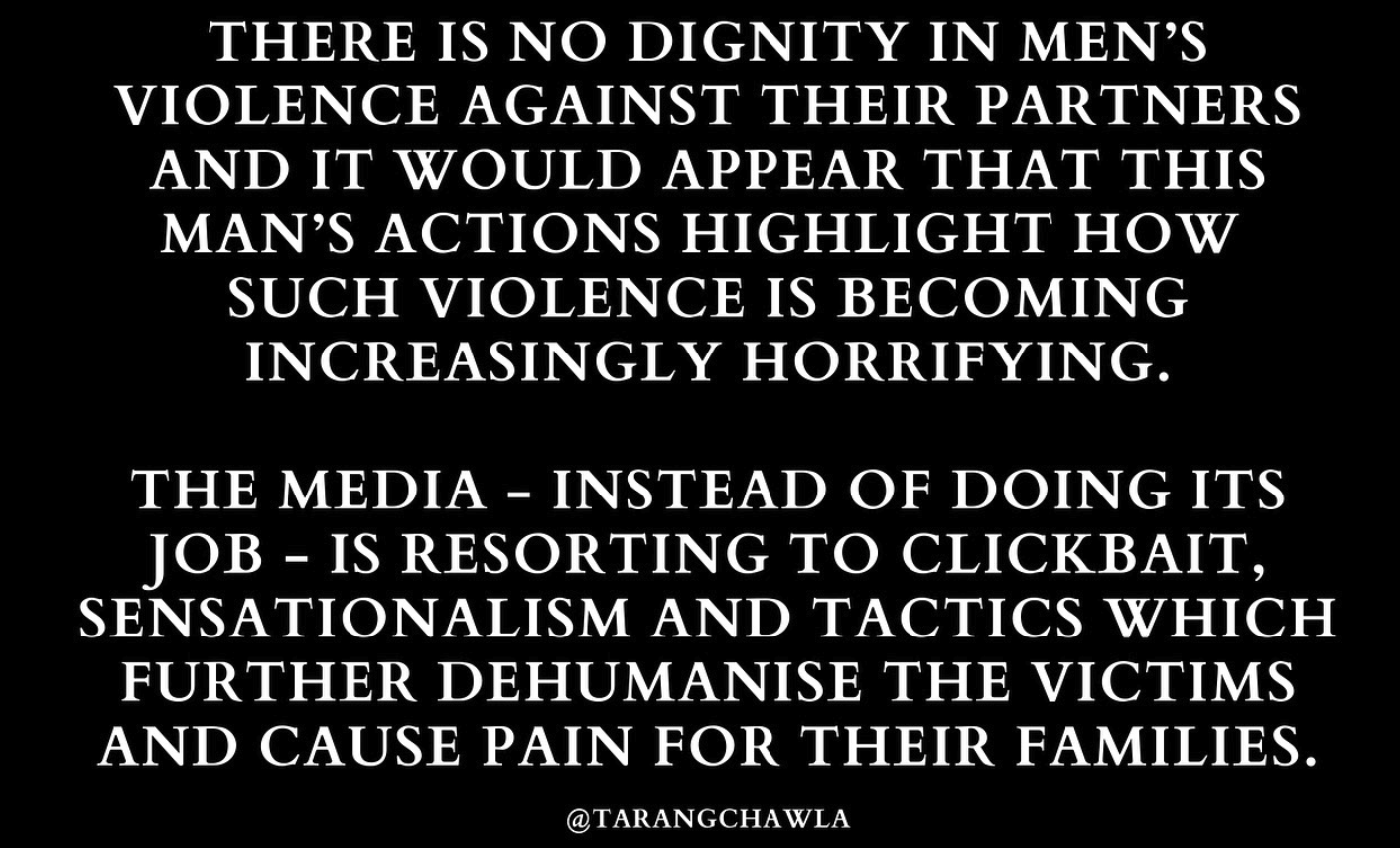
I swiped to read the other slides and was horrified by what I read. You might have seen this story on the nightly news or online. Apart from giving voice to the horrendous violence of this act, Tarang’s wider point is about media reporting.
Source: Tarang Chawla’s Intagram post

I won’t include the next slide in Tarang’s post, but the Australian media reporting of Kristina Joksimovic’s murder is deeply disturbing.

Tarang makes the point that women’s lives have become clicks. More clicks = more revenue.

Source: Tarang Chawla’s Intagram post

What views are being shaped by the grotesque reporting of Kristina Joksimovic’s murder?

Whose views are being shaped?

There were other reports I read on women’s murders this week, and on the dehumanising treatment of women – see the MFW Facebook page if you want to read more – and they all made me sad. Not only because of the treatment of women, but also because of how this treatment is being reported in our ‘news’ media, and how our views are being shaped by this reporting.

I was going to apologise for bringing the mood down, but I won’t. This is happening, we consume this reporting. What’s it doing to us?

Plans for the weekend

Mum arrives tonight for a weekend visit, and I had thought we might go to the Kyneton Daffodil and Arts Festival.

I just checked the forecast though and tommorrow’s high of just 8C and up to 8mm of rain isn’t inspiring me to get outside.

So we’ll see.

What I’m really trying to say is that we have no plans.

Sometimes those weekends are the best.

[Breaking: I just this minute received a text message reminding me of a dental appointment tomorrow morning. I’ve already put it off once, so I’m thinking I should get my big girls pants on and just go.]

F-word

Fancy.

Yep, that’s my f-word for the week.

We’ve had some more painting done inside and the place feels fancy.

And looks fabulous.

Love this colour: Bean Counter (Dulux)

So that’s it. My 3 questions and an F-word.

Thanks for reading Deb!

Posted in Uncategorized

Manners and public discourse

While I have had a Twitter account for just over a year now, I have not, until recently, given it much attention. Nor have I given much attention to my LinkedIn account. Over the past two weeks, for a reason I have yet to understand, I have taken to checking my Twitter and LinkedIn accounts on a very regular basis. I read through the tweets and articles that arrive during the night while eating rhubarb and ricotta for breakfast, and then I check again at lunch time and regularly throughout the evening. My daughters would call “nerd alert” if they could see who I follow (ABC News 24; The Guardian; BBC World News; Oxford University Press, etc) but that’s okay. Nerds are usually quite harmless and I don’t mind being counted amongst their number.

But that’s not the reason for this post. The point isn’t to tell you that I’ve become somewhat addicted to Twitter and LinkedIn, and to the information, ideas, perspectives, thinking, opinions, moments of humour and sometimes outrage to which I am now exposed.

The point is to try to make sense, for myself as much as anyone, of some of the things I’ve read in recent times.

One of the tweets that came through on Friday was news of a message to members of the Australian Army by Lt. General David Morrison, AO who was responding to reports of unacceptable behaviour.

I also read tweets about the questions put to the Prime Minister, Julia Gillard, by (former) Perth radio presenter, Howard Sattler.

The two things became linked in my mind, and also called to mind the list of things others have said about and to Prime Minister Gillard over the last two and a half years.

One of the things that Lt. General Morrison said in his message to members of the Australian Army (and let’s face it, to the rest of us given that it’s on YouTube for all to see) is that “every one of us is responsible for the culture and reputation of our Army”. What if we were to replace Army with “school” or “workplace, houses of Parliament, radio station or home”? Would what he said still apply? Are we responsible for the culture and reputation of where we work and live?

As an aside, he also said: “the standard you walk past is the standard you accept”. One thing I find interesting is that this hasn’t already been said loudly and clearly by an editor of a newspaper, a news director in a radio station, a senior executive of a TV station, a leader in the community … 

But I digress.

I stumbled across Angry is a Habit while reading articles on LinkedIn. It is a short blog post about habits. We have habits of behaviour, but Godin (the author of the post) suggests that our emotions can become habitual too.

I thought about this in relation to the words used by some in the media and wondered if the emotions behind their words are habitual ways of being. Why the need to pour hate and loathing and anger into the world? Is it just a habit? Do we, the consumers of these words, buy the emotion as well? Is it a package deal? When we read/hear/watch the angry, hate-filled words that we wouldn’t say to our boss, principal, Dean of the Faculty, chair of the Parents and Friends committee, head of the local arts organisation, do we buy the emotion too so that we get just as angry and hate-filled at whichever politician is being scorned, ridiculed, put down? Do the words cause us to feel particular things? Does hate and anger therefore spread through our communities in the same way that videos go viral on the internet?

From LinkedIn I also read Three words that will transform your career. In this article author Bruce Kasanoff claims that to improve our quality of life we just need to think “help this person” every time we encounter another person: “When you walk into Starbucks for coffee, think help this person about the barista who serves you. Instead of being frustrated that he isn’t moving fast enough, see if you can make him smile. Better yet, tell him to keep the change.” Kasanoff claims that this will “change your demeanour, your thought process, and the entire interaction.”

It is a similar sentiment to one put forward by David Foster Wallace in his now-famous speech to a group of university graduates in the US in 2005. While Bret Easton Ellis (author of American Psycho amongst other works) considers Foster Wallace “the most tedious, overrated, tortured, pretentious writer of my generation“, others have been taken with Wallace’s notion of choice … we can choose to behave in certain ways, we can choose to see the world in particular ways, we can choose to look beyond the surface and (although he didn’t use these words) we can choose empathy. We can choose to live beyond our “default setting” (of being annoyed and frustrated by, for instance, the slowness of airplane passengers when putting their bags in the overhead lockers; of being annoyed and frustrated that even when someone is eighth in the queue for the ATM they still don’t have their purse out of their handbag when they “suddenly” find themselves first in the queue, which has now grown to 23 tongue-clicking, foot-tapping withdrawers of money). We can choose to think/live/behave/feel differently.

So what have I learnt from all this reading? What sense am I making from these seemingly unrelated tweets, articles, speeches, thoughts? It has something to do with manners and respectful behaviour … but it also goes beyond that.

For me, one thing is clear: We can change our habitual ways of thinking and acting. To do this, we first need to become aware of how our thoughts impact our behaviour, speech, interactions, emotions. We need to consider our habits of thought and emotion and then to do something about them if we find ourselves thinking/feeling/acting negatively/rudely/in an ill-mannered way on a regular basis.

Through a change in thinking we can transform others’ lives and in the process transform our own as well.

We can stop walking past what we know (deep down) we don’t accept. We can speak up for respect, care, kindness, professionalism and manners. We don’t have to accept the hate and anger of radio shock-jocks and political commentators (of whatever persuasion). We don’t have to accept their hate-filled, angry, vitriolic rantings, and their disrespectful questioning, and their words which claim that we are all somehow implicated in their tawdry games (we continue to listen, to watch, to read, to buy, to comment and thus give them credibility or at the very least our time).

We can choose to think for ourselves, read critically, and ask questions of the texts produced and served to us on a regular basis. We can live by habit, or we can choose to live consciously, being explicitly aware of the world around us and how we are being shaped by the views/words/actions of others (yes, even of me in this blog post), and the ways our views/words/actions shape others.

If we are teachers, then we need to be even more aware of that influence.

None of this is new of course. Educator Wayne Sawyer, in an editorial he wrote in English in Australia in 2005, noted that “our current students face a relentless barrage of shockjocks, media barons, advertising and corporate greed masquerading as common sense” (p. 4). Sawyer called on teachers to ensure that critical literacy was an integral component of their teaching. But in order to do that, teachers too must be aware of how their views are being shaped by the same shock-jocks and media barons that shape our students’ thoughts. And more than that, we need to know how to deconstruct the messages they (and we) consume and know how to teach students to unpack them.

We can choose … that’s what I’ve learnt. We can choose.