Posted in Learning

Icons of Melbourne

My husband Tim has been engaged in a 365 (or is it 366 because of the leap year?) photographic project for almost … well, almost 365 days now.

Tim has invited me to end this project with him, and so I will be uploading an iconic image as I see it: two views of the same icon.

Our perspectives are quite different: I tend to be more literal, where Tim often tends towards the abstract. As in many things, we complement each other.

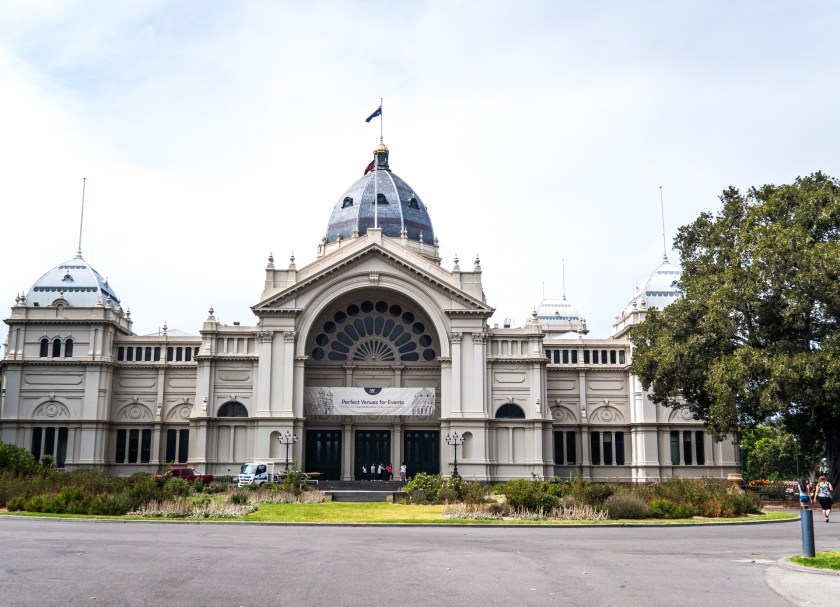
Below is my take on the Royal Exhibition Building; here is Tim’s.

P3050026
Royal Exhibition Building
Posted in Festival, Life

TumbaFest 2016

Tumbarumba is a little town, just off the Hume Highway, half way between Sydney and Melbourne. On the final weekend of February each year, locals and visitors gather on the banks of the creek to chat, soak up the sun, drink local wine, and eat locally produced food.

This is only my second TumbaFest; we came for the first time last year and enjoyed the relaxed nature of the day so much that we decided to come back this year. It helps that my sister and brother-in-law live here and so it’s also a great excuse to catch up with family.

The thing I like most about TumbaFest is the music. What better way to spend a sunny Saturday than sitting on the grass listening to great music? And dancing, should you be so inclined.

Here are some of my pics from TumbaFest. If you’re in the area on the final weekend of February next year, pop in. You’ll be glad you did.


Posted in Life

Ordinary stories

The road twists and turns around gently wooded slopes that rise up to form part of the caldera. We travel through farmland where lumpy cattle graze between old-fashioned fences, and then through bushland with shards of red and a thousand different greens. Tufts of grass draw a seam down the centre of the narrow potholed road whose edges are battered by heat and too many vehicles. An occasional house, a school, a rash of letterboxes: signs of human occupation, but you’d be excused for thinking that you’d travelled to a different time. It’s hard to believe that the shiny brashness of the Gold Coast is less than an hour away.

We turn left at Chillingham towards Tyalgum and I ask if Nan and Pop had ever lived here. No, they lived at Limpinwood, 15 minutes away (although possibly longer then), in a hut on the farm where Pop worked. And Nan worked there too: she cleaned ‘the house’. The hut Nan and Pop lived in had a dirt floor and my Dad, a baby at the time, slept in a box. Or so he tells us. The owner of the farm was ‘mean’ – but my mother isn’t sure what Nan meant by that.

I realise that while I have my own memories of Nan and Pop, I don’t know their stories. I am fascinated by my grandmother’s life because it’s so removed from my own. But I won’t ever know much of that life because the stories of ordinary life and ordinary lives get locked away; they remain untold. Not deliberately untold, but they seem not worth telling, unremarkable, just ‘how life was’. We lived here, we worked there, we drank tea, cooked meals, danced, laughed, cried. Ordinary things done by ordinary people.

And still I’m fascinated. And not just by Nan’s story but of other stories I hadn’t considered before.

I hadn’t ever thought to ask before how my sister came to be born in Murwillumbah when my parents lived in Sydney. It turns out that it was something Dad wanted. My mother, living alone while Dad was at sea in the Navy, lived in Sydney – the same city in which her parents, brother and sister lived. My father’s parents lived in Murwillumbah, with Dad’s two younger sisters and his (much) younger brother.

As Mum answered my questions, I started to think about how each family member’s story was different and unknown – at least to me. How did Nan react when Dad told her that her daughter-in-law would be moving in so that the baby could be born in Murwillumbah?

How did my mother react when she was told that she’d be having her first baby a thousand miles from home?

How did Dad’s teenage sisters and 7-year-old brother Robert react to the reality of a new ‘big sister’ living with them for an indefinite amount of time?

How did Mum’s mother react knowing that her first grandchild was going to be born in a little country town so far away?

How did either Pop react?

I have a thousand other questions. What drove the decision to move from a dirt-floored hut in Limpinwood to a room in a cottage in Byangum Rd Murwillumbah in 1938? Who was the decision-maker? What conversations went on between my grandparents to initiate the move? Who was the decisive one? Was ambition a part of the decision? Did my grandmother insist, or was my grandfather the decision-maker, as my father had been in the decision about where his eldest child would be born?

***

Dad and I went to the Tweed River Regional Museum in Murwillumbah through the week and read stories of the prominent people of the area: pioneers, entrepreneurs, business leaders. Mostly men, but stories of women too; people who nurtured the town into existence.

I sit at the kitchen table that has been part of my life since I was a teenager and think about all the generations who have come before me, nurturing the families of which I’m a part into existence.

In the centre of the table is a fruit bowl that is part of a set that was given to my great-aunt as a wedding present in 1934.

There are many such things tucked away in this house. Bowls that Dad brought back from an overseas trip in 1959 not long after he joined the Navy, the wooden tongs hanging in the laundry that Mum used when she washed clothes in the copper in the early 60s, the drawers that used to be in the bedroom I shared with my sister in the 70s.

Ordinary things that have stories wrapped around them. Things that have been, and will be again, passed down to those in the next generation – or the one after that.

What stories there are in the midst of the ordinariness of family life.

Which ones will be passed on?

Which ones will stay locked away?


Posted in Life, Writing

Spreading the (belated) love

My sister is a blogger (amongst many other things) and she’s taken to blogging like the proverbial duck to water. Deb is a community minded person; she loves to be part of things, to join in, to interact.

What that means for her blogging is that she gets involved in events and challenges and she responds to people and they respond back.

What it also means is that Deb gets nominated for blogging awards and to join in blogging challenges. One of these was to ‘spread the love‘.

These challenges/events have ‘rules’ which in this case were:

RULES

  1. Write ten four word sentences about what love means to you.
  2. Share your favourite quote on love.
  3. Nominate ten other bloggers for the same.

I was reading Wide in Tights’ blog just now and saw that Jen responded to Deb’s challenge, and so I thought I’d give it a go too. Plus, Deb had nominated me to participate in the event.

It’s not something I often (ever) do because I have a really hard time thinking about what to write when I’m given a topic to write on. But I’m going to give this a go. Except, I don’t know 10 bloggers so I’ll conveniently forget about that particular ‘rule’.

So here are my ten four word sentences:

1. Knowing Tim’s always there.

2. His warm, warm hands.

3. All of my children.

4. All of my grandchildren.

5. Spending time with family.

6. Summer warmth after winter.

7. Christmas at the beach.

8. Road trip to anywhere.

9. Being connected to others.

10. Dancing on the inside.

The challenge also called for a favourite quote on love … to be quite honest, I don’t have one, but I do like that Oscar Wilde said: “Never love anyone who treats you like you’re ordinary”.

It possibly doesn’t fit with the spirit of ‘spreading the love’ but it speaks to me and so I thought I’d share it.

****

There you go … my first blogging event/challenge.

Posted in Life

On illness …

My sister and I were talking yesterday.  In person. (We can do that now that we live closer to each other.)

We were discussing how like our mother we are in relation to illness. Mum has no truck with people who are sick. It’s all in their heads. If they wanted to get better they would, and if they’d been more determined they wouldn’t have been sick in the first place. You sneeze and say I’m getting a cold and Mum would respond with ‘stop it. You’ll talk yourself into getting sick’.

Deb and I are like our mother. People allow themselves to get sick. They don’t talk themselves out of it. We have an absolute conviction that illness can be stopped with the right attitude. In fact, Dad used to say it a lot when we were kids: mind over matter. We developed strong minds.

Deb and I are doomed – it comes from both parents.

I felt good yesterday to discover that I wasn’t the only one with this attitude (besides my mother). Deb has it too. We joked about it, and felt good about being so self-aware as we wondered down the main street of Bright, laughing that it was only in this that we were like our mother.

Our self-awareness hasn’t changed our attitude though.

And without wanting to jinx ourselves, Deb and I tend not to get sick. And neither does Mum. Everyone around us might be burning up with fever, coughing and sneezing their hearts out, have throats red raw, be laid flat with whatever’s going around and we tend to sail on through unscathed.

When we do get sick though, we get sick. Mum was sick earlier in the year. Her and Dad were visiting Tasmania and then our new place and she wasn’t at all well. But would she take it easy? Not on your life! No giving in to a cold, no spending time resting up … taking it easy is for wimps, and by golly our mother is not a wimp.

Sickness is for the weak, and she is strong.

Let me just say, as an aside, that people who have this attitude are very bad patients!

Deb and I have, it seems, inherited her attitude. And thankfully, her constitution. We rarely get sick.

We joke about our attitude, and in mixed company pretend that we really don’t think that sickness is for the weak and that if you really wanted you wouldn’t get sick in the first place … but in our hearts we know that it’s not pretend. It’s a truth we live with.

It’s not an easy thing to admit so openly. Turn it around for a moment and imagine how hard it must be for us, having no patience with a loved one curled up in a ball on the couch, red-nosed and sounding like Shirley Bassey on a bad day. Imagine how difficult it is for us to make soothing noises, to make chicken soup, to fuss over the pain-ridden … oh forget it, you obviously didn’t look after yourself properly and you’ve let yourself get sick. Stop giving in to it.

There, I’ve said it. It’s out there.

But, we know about our attitude and we are pleased that as we get older we’re better at biting our tongues and being sympathetic.

Or so we think.

Our husbands, it seems, think differently.

Posted in Learning, Life

On moving …

On August 18, 1986, as a 24 year old mother of four young children, I moved from Brisbane to Tasmania; from being surrounded by family, to a place where we had no family; from a city to a sheep farm; from the relative warmth of a Queensland winter to the depths of a Tasmanian one.

I felt sentenced, although unsure of the length of my sentence.

****

It turns out my sentence was 27 years, 10 months, and 22 days (or thereabouts).

On Wednesday 25th June, 2014, my sentence ended.

Despite the ‘sentence’, Tasmania ended up being a good place to live – a cold one and I have complained often and bitterly over the years about the cold – but looking back it’s easy to focus on the good parts of living in the state that’s been the butt of mainlanders’ jokes for many years.

During my 27 years and a bit years, I (in no particular order):
* ran a general store in a very small country town
* had a fifth child
* worked in community radio
* completed an undergraduate degree specialising in English and Drama teaching
* taught in a high school and a senior secondary college
* got my bus licence
* taught Drama and English and Tourism Studies
* completed Cert IV in Workplace Training and Assessment
* worked for ABC Local Radio as a producer and presenter
* began A Kick in the Arts – a weekly community radio arts program
* returned to university and completed a PhD
* became an academic and took on a range of leadership roles
* was the chair of a local theatre company for a time
* lived in the north-east, the north-west, and the north – and then the north-west and then the north and then the north-west
* divorced
* re-married 19 years later
* undertook the year-long Tasmanian Leaders Program
* travelled to the mainland whenever I could
* travelled to New Zealand twice, then Scotland and England one year, to Paris and Germany the next and then to France, Italy and Germany the one after that
* published a number of journal articles, book chapters, and conference papers
* edited a textbook
* presented papers in Christchurch, Glasgow, Adelaide, Brisbane, Melbourne, Hobart, and Launceston
* welcomed eight grandchildren into the world
* taught more students than I could ever remember
* supervised four PhD candidates to completion
* put on lots of weight
* lost even more
* met some truly wonderful people

****

I moved to Tasmania because of my (then) husband’s job.

Almost 28 years later, I’ve moved away from Tasmania because of my (now) husband’s job.

****

It’s unsettling, this moving business. Sorting out possessions stashed in dark corners of cupboards; throwing out; packing up; spending weekends in Melbourne and week days in Burnie; moving between … between living with my husband in Melbourne on weekends and living with one of my daughters and her two sons through the week. Not feeling like either place is home … one new place that isn’t really mine, and the old, familiar place that is now filled with boys’ toys and laughter and tears and hugs and bubble baths – changed, in a good way, but not really mine. Moving between having my husband cook me dinner on the weekends and cooking dinner for my daughter through the week … between gyms … between relying on public transport and having no public transport … between there and here … and here and there.

My husband and I called two different places home … it was confusing for a time. Where? Oh, that home.

A long time in transition – four months of living between. Not long, looking back … but it felt long living through it.

And now it’s done. The final move … three trips across Bass Strait in five days, each rougher than the one before. Unpacking the car, finding dark corners of cupboards to stash our things, having one home rather than two.

I don’t feel sentenced, in this new place.

I already feel more connected.

And less.


Posted in Life

A personal plea …

Dear follower,

I don’t usually use my blog to promote causes, but this one is a little different, and one I feel passionate about.

This is to let you know that I’m participating in the Run Melbourne 5km event https://runmelbourne2014.everydayhero.com/au/sharon-8  and will be proudly supporting The Shake It Up Australia Foundation to raise funds to find a cure for Parkinson’s disease, in this life time.

Every day 30 people in Australia are diagnosed with Parkinson’s, and as many as 10% of these people are under the age of 40. This disease currently has no known cure, however through investment in research targeted at finding a cure Shake It Up Australia Foundation and their partner The Michael J Fox Foundation For Medical Research offer hope.

Helping to find a cure for Parkinson’s is something very dear to my heart and I’d really appreciate your support to help me reach my fundraising goal for this great cause.

Here are some ways you can personally help me right now

  • Share my fundraising page with your friends and family
  • Look out for regular updates here to keep abreast of my progress.

Thank you for your support. I really do appreciate it,

Sharon

Posted in Learning, Life, Writing

Random observations and thoughts

A pirate sits in his car, texting with his eye patch up, while the news blares from his radio.

A silver and a pink balloon float above a fencepost at a house around the corner.

A car does a U-turn outside the house, crunches against the curb and comes to a complete stop. It seems perplexed.

***

My dress is ready. I’m on my way to the dressmaker now. I’d been walking past the Red Cross shop a few days ago and felt compelled to go in. There it was. A grey wool dress with a touch of black satin at the neckline and cuffs. Simple. Elegant. Beautiful.

Size small.

I tried it on anyway.

Max Mara, the girl with the German accent told me.

It needed a little re-stitching.

It’s ready now. I try it on.

It’s beautiful.

***

I sit in the downstairs section of the library. I’d ignored the signs saying staff and students only. I am neither a staff member nor a student of this particular institution but I figure that if I look confident no one will notice me.

I find a table in the group learning section. I don’t have a group. I sit at the table alone, surrounded by groups of students, with my laptop open, marking.

Conversations swirl around me. Ideas, concepts, understandings, clarifications, possibilities. Multiple languages. Multiple disciplines. Maths. Graphic design. Nutrition. Engineering. A glass wall covered in formula. Portfolios scattered across tables. Laughter. Swearing. Questions. Comprehension. Propositions.

Intellectual and social and professional engagement.

I wonder about the spaces we create for online students to engage in these rigorous conversations.

Tim says: I’m going to the city with my camera.

I let other thoughts go. They are puzzles for another time.

Now is the time for wandering.


Posted in Learning, Life, Writing

Writing at Rosie’s

I spent the weekend at Rosie’s, retreating. That is, Rosie led a retreat in which I participated. If you don’t know her, you’re missing someone special! Rosie is elegant and gracious. More than that, she is full of grace and wisdom. Rosie affirms and honours people; she is gentle and patient and fabulous to be around. I’m glad she’s my friend.

Rosie asked why she hadn’t seen me on Twitter much lately and I responded that I had nothing to say. It’s why I haven’t blogged for a while as well.

Sometimes I like silence. Actually, a lot of the time I like silence. I can sit around a dinner table with a group of women and get to the end of the night without having said a word.

And that’s okay.  I like it that way. I get to listen to ideas and perspectives that are different from my own and tuck them away to think on later. To wonder how others come to have different perspectives and ideas and attitudes and beliefs and wonder more deeply about my own and how they’ve been shaped.

I get to hear of others’ experiences and the stories they tell of their lives.  Lives full of richness and colour and emotion. Relationships, places I’ve never been, things I’ll never do.

I learn about the tapestry of others’ lives: the weaving of experiences and reactions to those experiences, and come to some understandings about how others live and think and be.

I read blogs and comments on blogs, (and am dismayed by the negativity that abounds at times), but I don’t always feel the need to speak; to write. Listening is good.

But Rosie reminded me that writing is good too. There are times when I need to get my thoughts out of my head and onto paper so that I can see my thinking. It is only then that it begins to make sense to me. My head isn’t big enough to keep all of my thoughts inside; I need them laid out, visible, so that I can determine the ones that I feel un/comfortable with, challenged by, or determined to follow through with. I can make connections between the threads of thoughts when I can see them; a task I find much more difficult when they’re tangled around each other inside my mind.

Rosie gave us a journal and asked us to write in it. I did, even when the activity called for a more visual way of thinking. I wrote a lot, made some decisions, felt better. And all because I could see my thinking on the page.

I learnt (again) that sometimes, when you feel as though you have nothing to say, writing can help you move through that.

I also learnt (again) to own my statements, so I’ll write that again: I learnt (again) that sometimes, when I feel as though I have nothing to say, writing can help me move through that.

Thanks Rosie!


Posted in Life

Strange familiarity

I’m typing on a familiar computer, in a familiar corner of the big room upstairs, but the table is unfamiliar and therefore the act of typing is different.

While the corner of the room is familiar – it’s where my desk has been for the past four years and three months – the room itself is different.

Downstairs, in the kitchen, I open the drawer for a glass and it’s different. Not a different drawer or a different glass, but the drawer is emptier and therefore the experience of choosing a glass is different.

I step into my bedroom and the familiar bed and bedside table are there, but the rest is different. Chester is no longer where it’s been for the past four years and three months; the bookshelf full of mementos from former students and books with hard covers is gone; even Tim’s sock drawer cupboard is no longer there. Tim’s side of the wardrobe is now full of my clothes – what’s he going to wear, I wonder, for the next week/s?

Things are different within the familiarity of each room. There’s a piano in my dining room; a spider plant occupies the space where my pedestal used to stand in the lounge room; a canvas of a scene from Natone is on the wall where a scene from Scottsdale used to hang. The TV is smaller and the screen that covered the mess of cords is gone. Not so the mess of cords!

It’s disconcerting. Strange.

I open the pantry and immediately feel to comfort of the familiar; I stand there, like an old lady who’s forgotten what she went to the pantry for, just to feel the refreshment of familiarity.

But the fridge is different and the cutlery drawer is full of plastic knives and forks. I am disconcerted again.

I look in the mirror and see my familiar face, and it’s the same … but not quite. There’s a change, a small one, but a change nevertheless. I had forgotten, and for a moment am caught out. Then look away, seeking the familiar.

But at every turn, something has changed. It’s strangely familiar, but just as strangely unfamiliar.

I

am

discombobulated.

It’s not comfortable.