Posted in Photography

Icons of Melbourne #7

Melbourne is known for its laneways, and the artworks that adorn the walls of many of them.

Hosier Lane, just off Flinders St, is one of the better-known laneways, particularly for its art. While I am interested in the works done by very talented artists, I am perhaps more interested in the ways others use the laneway.

That’s what this image represents for me … the use of the laneway as a backdrop for a hiphop video being produced on a quiet Sunday morning.

Tim’s interpretation of Hosier Lane is here.

Video production in Hosier Lane
Posted in Photography

Icons of Melbourne #5

The Melbourne Star revolves slowly on its unequal-star axis.
Colours pulse, change, move, are extinguished, then re-ignite the skyline.

***

Here is my  literal interpretation of a Melbourne icon.

See Tim’s interpretation here.

Melbourne Star
Melbourne Star


I attempted a more abstract interpretation.

A more abstract view of the Melbourne Star.
Posted in Photography

Icons of Melbourne #4

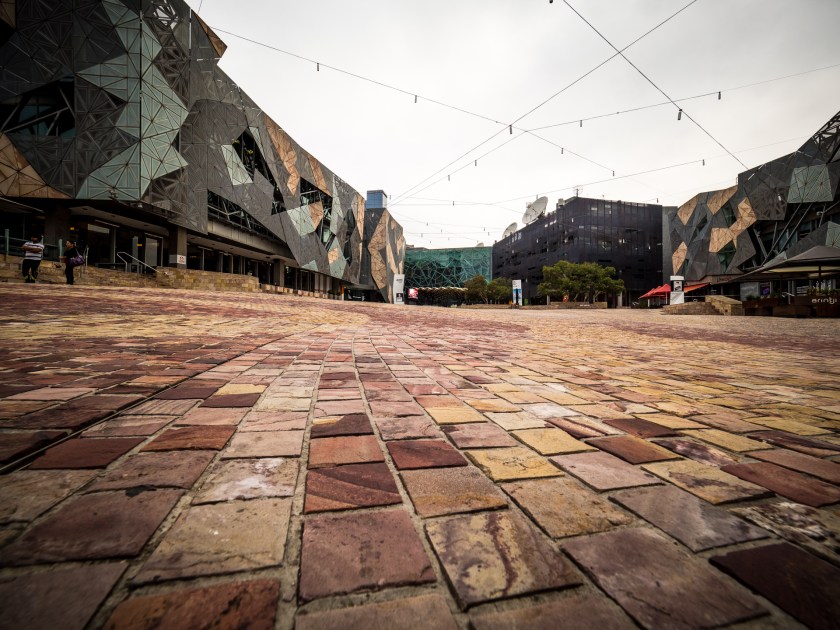
‘Fed’ Square is a place where people gather – to eat, talk, listen to music/those with something to say.

The buildings that surround the square become topics of conversation too … not just for what they house, but mainly for how they look.

On this particular morning the square was empty, apart from the occasional pigeon and a security guard or two, emphasising, to my mind at least, the gathering-space nature of this place. That’s how I’ve decided to interpret today’s Melbourne icon.

Tim’s interpretation of Fed Square is here.

Fed Square
Fed Square
Posted in Learning

Icons of Melbourne

My husband Tim has been engaged in a 365 (or is it 366 because of the leap year?) photographic project for almost … well, almost 365 days now.

Tim has invited me to end this project with him, and so I will be uploading an iconic image as I see it: two views of the same icon.

Our perspectives are quite different: I tend to be more literal, where Tim often tends towards the abstract. As in many things, we complement each other.

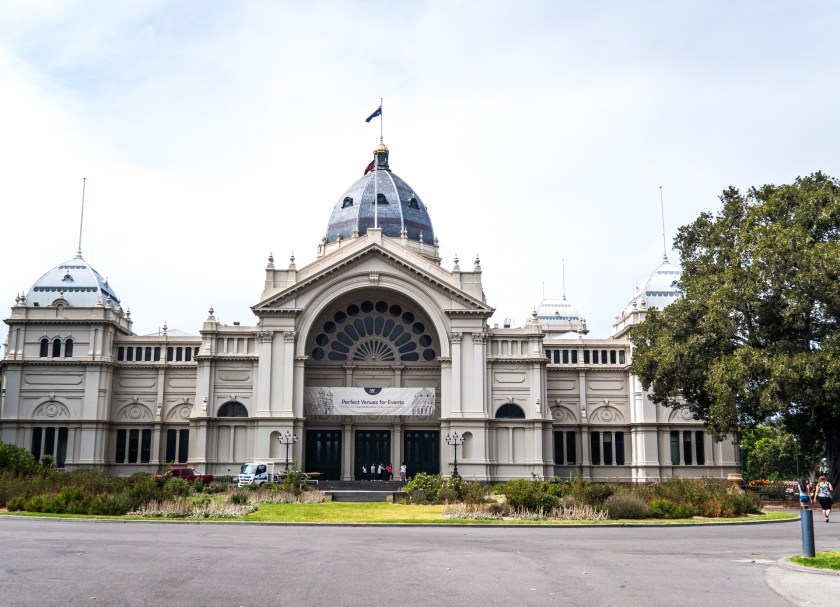
Below is my take on the Royal Exhibition Building; here is Tim’s.

P3050026
Royal Exhibition Building
Posted in Festival, Life

TumbaFest 2016

Tumbarumba is a little town, just off the Hume Highway, half way between Sydney and Melbourne. On the final weekend of February each year, locals and visitors gather on the banks of the creek to chat, soak up the sun, drink local wine, and eat locally produced food.

This is only my second TumbaFest; we came for the first time last year and enjoyed the relaxed nature of the day so much that we decided to come back this year. It helps that my sister and brother-in-law live here and so it’s also a great excuse to catch up with family.

The thing I like most about TumbaFest is the music. What better way to spend a sunny Saturday than sitting on the grass listening to great music? And dancing, should you be so inclined.

Here are some of my pics from TumbaFest. If you’re in the area on the final weekend of February next year, pop in. You’ll be glad you did.


Posted in Learning, Life

On moving …

On August 18, 1986, as a 24 year old mother of four young children, I moved from Brisbane to Tasmania; from being surrounded by family, to a place where we had no family; from a city to a sheep farm; from the relative warmth of a Queensland winter to the depths of a Tasmanian one.

I felt sentenced, although unsure of the length of my sentence.

****

It turns out my sentence was 27 years, 10 months, and 22 days (or thereabouts).

On Wednesday 25th June, 2014, my sentence ended.

Despite the ‘sentence’, Tasmania ended up being a good place to live – a cold one and I have complained often and bitterly over the years about the cold – but looking back it’s easy to focus on the good parts of living in the state that’s been the butt of mainlanders’ jokes for many years.

During my 27 years and a bit years, I (in no particular order):
* ran a general store in a very small country town
* had a fifth child
* worked in community radio
* completed an undergraduate degree specialising in English and Drama teaching
* taught in a high school and a senior secondary college
* got my bus licence
* taught Drama and English and Tourism Studies
* completed Cert IV in Workplace Training and Assessment
* worked for ABC Local Radio as a producer and presenter
* began A Kick in the Arts – a weekly community radio arts program
* returned to university and completed a PhD
* became an academic and took on a range of leadership roles
* was the chair of a local theatre company for a time
* lived in the north-east, the north-west, and the north – and then the north-west and then the north and then the north-west
* divorced
* re-married 19 years later
* undertook the year-long Tasmanian Leaders Program
* travelled to the mainland whenever I could
* travelled to New Zealand twice, then Scotland and England one year, to Paris and Germany the next and then to France, Italy and Germany the one after that
* published a number of journal articles, book chapters, and conference papers
* edited a textbook
* presented papers in Christchurch, Glasgow, Adelaide, Brisbane, Melbourne, Hobart, and Launceston
* welcomed eight grandchildren into the world
* taught more students than I could ever remember
* supervised four PhD candidates to completion
* put on lots of weight
* lost even more
* met some truly wonderful people

****

I moved to Tasmania because of my (then) husband’s job.

Almost 28 years later, I’ve moved away from Tasmania because of my (now) husband’s job.

****

It’s unsettling, this moving business. Sorting out possessions stashed in dark corners of cupboards; throwing out; packing up; spending weekends in Melbourne and week days in Burnie; moving between … between living with my husband in Melbourne on weekends and living with one of my daughters and her two sons through the week. Not feeling like either place is home … one new place that isn’t really mine, and the old, familiar place that is now filled with boys’ toys and laughter and tears and hugs and bubble baths – changed, in a good way, but not really mine. Moving between having my husband cook me dinner on the weekends and cooking dinner for my daughter through the week … between gyms … between relying on public transport and having no public transport … between there and here … and here and there.

My husband and I called two different places home … it was confusing for a time. Where? Oh, that home.

A long time in transition – four months of living between. Not long, looking back … but it felt long living through it.

And now it’s done. The final move … three trips across Bass Strait in five days, each rougher than the one before. Unpacking the car, finding dark corners of cupboards to stash our things, having one home rather than two.

I don’t feel sentenced, in this new place.

I already feel more connected.

And less.


Posted in Life

A personal plea …

Dear follower,

I don’t usually use my blog to promote causes, but this one is a little different, and one I feel passionate about.

This is to let you know that I’m participating in the Run Melbourne 5km event https://runmelbourne2014.everydayhero.com/au/sharon-8  and will be proudly supporting The Shake It Up Australia Foundation to raise funds to find a cure for Parkinson’s disease, in this life time.

Every day 30 people in Australia are diagnosed with Parkinson’s, and as many as 10% of these people are under the age of 40. This disease currently has no known cure, however through investment in research targeted at finding a cure Shake It Up Australia Foundation and their partner The Michael J Fox Foundation For Medical Research offer hope.

Helping to find a cure for Parkinson’s is something very dear to my heart and I’d really appreciate your support to help me reach my fundraising goal for this great cause.

Here are some ways you can personally help me right now

  • Share my fundraising page with your friends and family
  • Look out for regular updates here to keep abreast of my progress.

Thank you for your support. I really do appreciate it,

Sharon

Posted in 100 Strangers, Life

100 Strangers Project

I thought it might be timely to add a reminder about my 100 Strangers Project here.

Click here … 100 Strangers

It is going slowly, much more slowly than I intended it to, but I’ve just added a few more strangers, and there are still some more to come … so don’t forget to bookmark the site and check it out, or you can go there and follow me so that you get a notification about updates whenever I add more strangers.

Here are some other strangers that I can’t add to the project, but I thought worth sharing anyway!

1. _B080016

2._B080039

3._B080046

4._B080022

Posted in Uncategorized

Manners and public discourse

While I have had a Twitter account for just over a year now, I have not, until recently, given it much attention. Nor have I given much attention to my LinkedIn account. Over the past two weeks, for a reason I have yet to understand, I have taken to checking my Twitter and LinkedIn accounts on a very regular basis. I read through the tweets and articles that arrive during the night while eating rhubarb and ricotta for breakfast, and then I check again at lunch time and regularly throughout the evening. My daughters would call “nerd alert” if they could see who I follow (ABC News 24; The Guardian; BBC World News; Oxford University Press, etc) but that’s okay. Nerds are usually quite harmless and I don’t mind being counted amongst their number.

But that’s not the reason for this post. The point isn’t to tell you that I’ve become somewhat addicted to Twitter and LinkedIn, and to the information, ideas, perspectives, thinking, opinions, moments of humour and sometimes outrage to which I am now exposed.

The point is to try to make sense, for myself as much as anyone, of some of the things I’ve read in recent times.

One of the tweets that came through on Friday was news of a message to members of the Australian Army by Lt. General David Morrison, AO who was responding to reports of unacceptable behaviour.

I also read tweets about the questions put to the Prime Minister, Julia Gillard, by (former) Perth radio presenter, Howard Sattler.

The two things became linked in my mind, and also called to mind the list of things others have said about and to Prime Minister Gillard over the last two and a half years.

One of the things that Lt. General Morrison said in his message to members of the Australian Army (and let’s face it, to the rest of us given that it’s on YouTube for all to see) is that “every one of us is responsible for the culture and reputation of our Army”. What if we were to replace Army with “school” or “workplace, houses of Parliament, radio station or home”? Would what he said still apply? Are we responsible for the culture and reputation of where we work and live?

As an aside, he also said: “the standard you walk past is the standard you accept”. One thing I find interesting is that this hasn’t already been said loudly and clearly by an editor of a newspaper, a news director in a radio station, a senior executive of a TV station, a leader in the community … 

But I digress.

I stumbled across Angry is a Habit while reading articles on LinkedIn. It is a short blog post about habits. We have habits of behaviour, but Godin (the author of the post) suggests that our emotions can become habitual too.

I thought about this in relation to the words used by some in the media and wondered if the emotions behind their words are habitual ways of being. Why the need to pour hate and loathing and anger into the world? Is it just a habit? Do we, the consumers of these words, buy the emotion as well? Is it a package deal? When we read/hear/watch the angry, hate-filled words that we wouldn’t say to our boss, principal, Dean of the Faculty, chair of the Parents and Friends committee, head of the local arts organisation, do we buy the emotion too so that we get just as angry and hate-filled at whichever politician is being scorned, ridiculed, put down? Do the words cause us to feel particular things? Does hate and anger therefore spread through our communities in the same way that videos go viral on the internet?

From LinkedIn I also read Three words that will transform your career. In this article author Bruce Kasanoff claims that to improve our quality of life we just need to think “help this person” every time we encounter another person: “When you walk into Starbucks for coffee, think help this person about the barista who serves you. Instead of being frustrated that he isn’t moving fast enough, see if you can make him smile. Better yet, tell him to keep the change.” Kasanoff claims that this will “change your demeanour, your thought process, and the entire interaction.”

It is a similar sentiment to one put forward by David Foster Wallace in his now-famous speech to a group of university graduates in the US in 2005. While Bret Easton Ellis (author of American Psycho amongst other works) considers Foster Wallace “the most tedious, overrated, tortured, pretentious writer of my generation“, others have been taken with Wallace’s notion of choice … we can choose to behave in certain ways, we can choose to see the world in particular ways, we can choose to look beyond the surface and (although he didn’t use these words) we can choose empathy. We can choose to live beyond our “default setting” (of being annoyed and frustrated by, for instance, the slowness of airplane passengers when putting their bags in the overhead lockers; of being annoyed and frustrated that even when someone is eighth in the queue for the ATM they still don’t have their purse out of their handbag when they “suddenly” find themselves first in the queue, which has now grown to 23 tongue-clicking, foot-tapping withdrawers of money). We can choose to think/live/behave/feel differently.

So what have I learnt from all this reading? What sense am I making from these seemingly unrelated tweets, articles, speeches, thoughts? It has something to do with manners and respectful behaviour … but it also goes beyond that.

For me, one thing is clear: We can change our habitual ways of thinking and acting. To do this, we first need to become aware of how our thoughts impact our behaviour, speech, interactions, emotions. We need to consider our habits of thought and emotion and then to do something about them if we find ourselves thinking/feeling/acting negatively/rudely/in an ill-mannered way on a regular basis.

Through a change in thinking we can transform others’ lives and in the process transform our own as well.

We can stop walking past what we know (deep down) we don’t accept. We can speak up for respect, care, kindness, professionalism and manners. We don’t have to accept the hate and anger of radio shock-jocks and political commentators (of whatever persuasion). We don’t have to accept their hate-filled, angry, vitriolic rantings, and their disrespectful questioning, and their words which claim that we are all somehow implicated in their tawdry games (we continue to listen, to watch, to read, to buy, to comment and thus give them credibility or at the very least our time).

We can choose to think for ourselves, read critically, and ask questions of the texts produced and served to us on a regular basis. We can live by habit, or we can choose to live consciously, being explicitly aware of the world around us and how we are being shaped by the views/words/actions of others (yes, even of me in this blog post), and the ways our views/words/actions shape others.

If we are teachers, then we need to be even more aware of that influence.

None of this is new of course. Educator Wayne Sawyer, in an editorial he wrote in English in Australia in 2005, noted that “our current students face a relentless barrage of shockjocks, media barons, advertising and corporate greed masquerading as common sense” (p. 4). Sawyer called on teachers to ensure that critical literacy was an integral component of their teaching. But in order to do that, teachers too must be aware of how their views are being shaped by the same shock-jocks and media barons that shape our students’ thoughts. And more than that, we need to know how to deconstruct the messages they (and we) consume and know how to teach students to unpack them.

We can choose … that’s what I’ve learnt. We can choose.