There’s been a single sock sitting on the chest of drawers for months. I check each load of washing carefully for its partner, but no luck. The sock has stayed single.
Another lone sock joined it for a while, and for a brief moment it looked like they’d make an unlikely pair. I mean, who says socks need to match? But soon enough, that second sock’s partner showed up, leaving the first sock on its own again.
And then yesterday, while putting other socks away, there it was, the missing partner. It had been in the drawer all along. Two single socks became a pair again.
I thought about that sock. How it wasn’t doing any harm, sitting there. How it was never really lost. And how, when I wasn’t actively looking for its partner, it just turned up. Almost like magic.
This week’s word for our photography challenge is flower, so I opened my photo album to see if I had any decent flower photos. Scrolling through, I came across images from years ago I’d forgotten. Photos I’d dismissed because I couldn’t see anything of value in them. This time, looking again, I noticed a similarity running through them – dare I say, a style. It had been there all along apparently.
Like the sock in the drawer, these photos weren’t lost. They just needed me to realise that sometimes what we’re looking for isn’t found by looking, but by recognising.
For four years, some members of my family have been involved in a weekly photo challenge. This challenge morphed from previous photo challenges we’ve done over the years, but in its current form, this one has been going for four years. Each week we have a word as our focus and we take photos of a representation of that word, share it in a private Facebook group and each Sunday night we Zoom, have a chat about our week, and talk about the photos.
This week just gone, the word was ‘play’.
It got me thinking.
This blog ‘Musings from the cold’ has a subtitle: playing with ideas and images. It’s something I enjoy – to look at a subject from different angles and see what stories emerge. I’m not always successful of course, but that’s what playing is all about – experimenting, seeing differently, trying out other voices and seeing what feels weird and whether I can sit with the weirdness.
I play photographically, but I realised I don’t often play with my writing. Not here anyway, on the pages of this blog. Over the years I have written many different sorts of things – journal articles, conference papers, book chapters for academic books, textbooks, newletters for parents and staff when I was teaching, interview questions and intros when I worked in radio and scripts for an Arts program I used to produce and present, poems on the fridge. Different audiences, different purposes, different styles.
But I realised through the week, that I only write in first person on this blog and so I decided to play, to experiment, to try a different voice. It felt weird, but I chose to sit with it, to keep writing in that style to see what I could learn from it, determined to push through the distance it gave my writing from myself until I found something new – well, new for me at least.
I wanted to play, and through that play to develop as a writer. It was never meant to be an endpoint, a final stop in my learning about writing – it was to help me go on a journey from one voice to another, one style to others (many, multiple) – to begin opening up the possibilities for my own writing.
When my youngest daughter was in Grade 3, the teacher asked them to write a story about their weekend every Monday. At a parent-teacher interview, the teacher commented that we lived the most interesting life. I knew this not to be true and asked her how she came to that conclusion. Apparently Emma’s Monday journal writing embellished our weekends to a point where they didn’t reflect our reality at all.
The teacher told her to only write what was true.
Emma stopped writing. Boring weekends didn’t interest her, and if the rule was to report only the facts rather than invent stories and worlds and interesting characters we met along the way, then there was no play left in it. And without play, the writing lost its spark.
It’s a reminder for my own practice. Play matters. It keeps my writing alive. So I’ll keep playing – with words, with voices, with styles that don’t quite fit until maybe they do. I don’t know yet where that will lead, but I suspect the detours matter as much as the destinations. If you find me writing strangely now and then, think of it as an experiment. You’re welcome to play along.
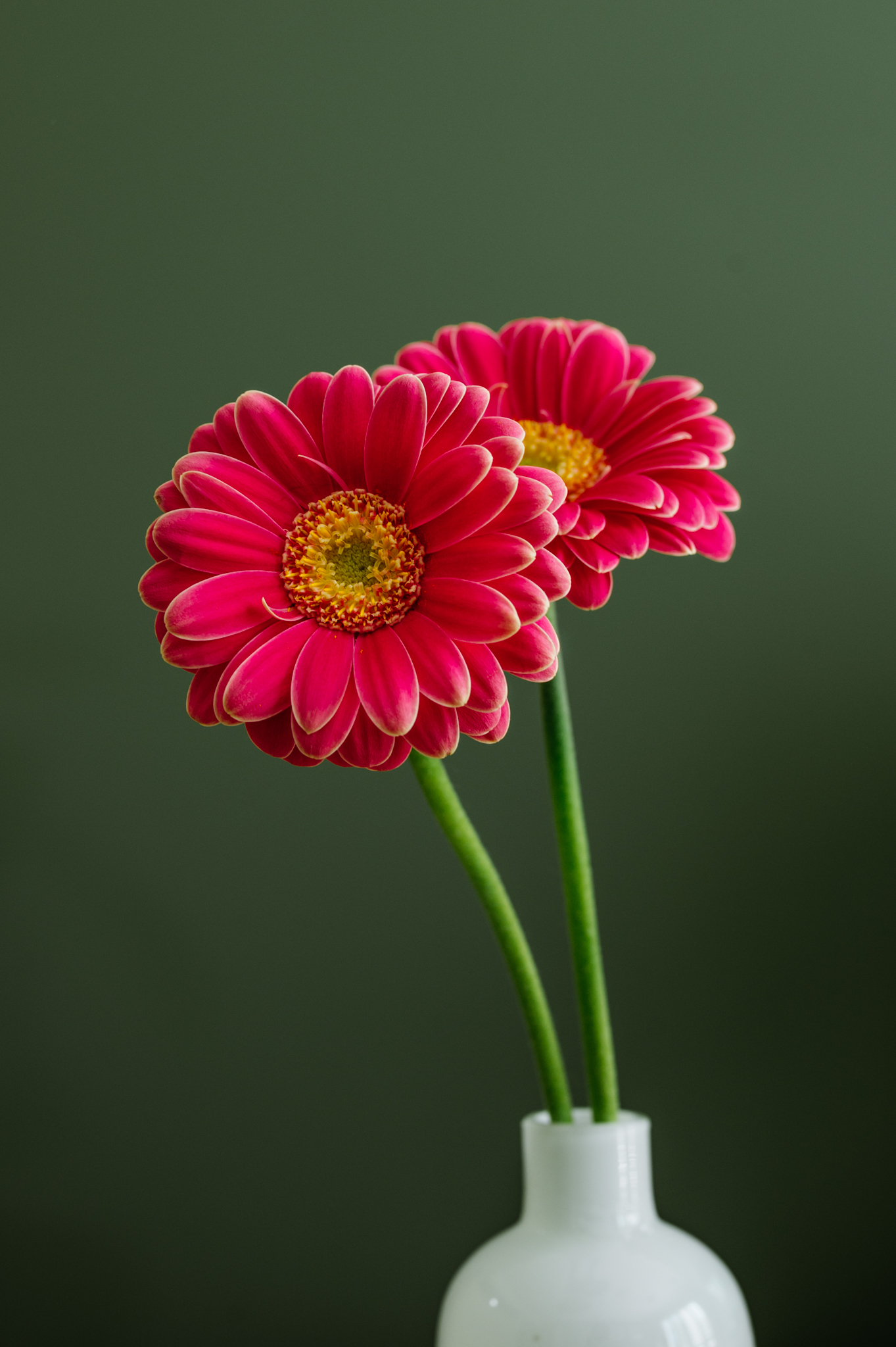
When I was first given a camera, sometime around 2007, I had no idea how it worked or what I would photograph. But I did know something about light from my time at university and so I experimented. A halogen lamp. An oven tray wrapped in aluminium foil. Windows with lace curtains. I bought flowers from the local florist – single stems arranged in whatever came to hand (a vase, a jar, a glass) – and set them up in areas of the lounge room. And then I played with the light … and learnt how to use the camera.
One wall of the lounge room was painted green, and it became my backdrop. The flowers stood out against it, classical and beautiful. I started to take the camera further afield – to the botanical gardens in Hobart, City Park in Launceston, the rhododendron gardens in Burnie. I photographed red hot pokers and made them redder, the daffodils that popped up unexpectedly under the rose bush in the backyard, and the insides of camellias.
Over time, I started photographing people – people I passed in the Bourke Street mall, those lingering near the steps of H&M listening to the buskers, those waiting at the lights on King Street, or outside Flinders St station. Sometimes I asked permission, sometimes I simply asked by lifting my camera, but always there was a burst of courage required in the approach. Most said yes. Some said no. I learned not to take refusals personally. And not to ask women of a particular age – they always said no. I loved the small exchanges: the older women who wanted to chat, the stories shared in passing, the faces that lingered in my memory – Jiggy, Brabh, Junior, Lisa, Samyrah, Belle, George. I gathered these portraits into a book, Faces of Melbourne – and printed one copy only. It’s one of my favourites.
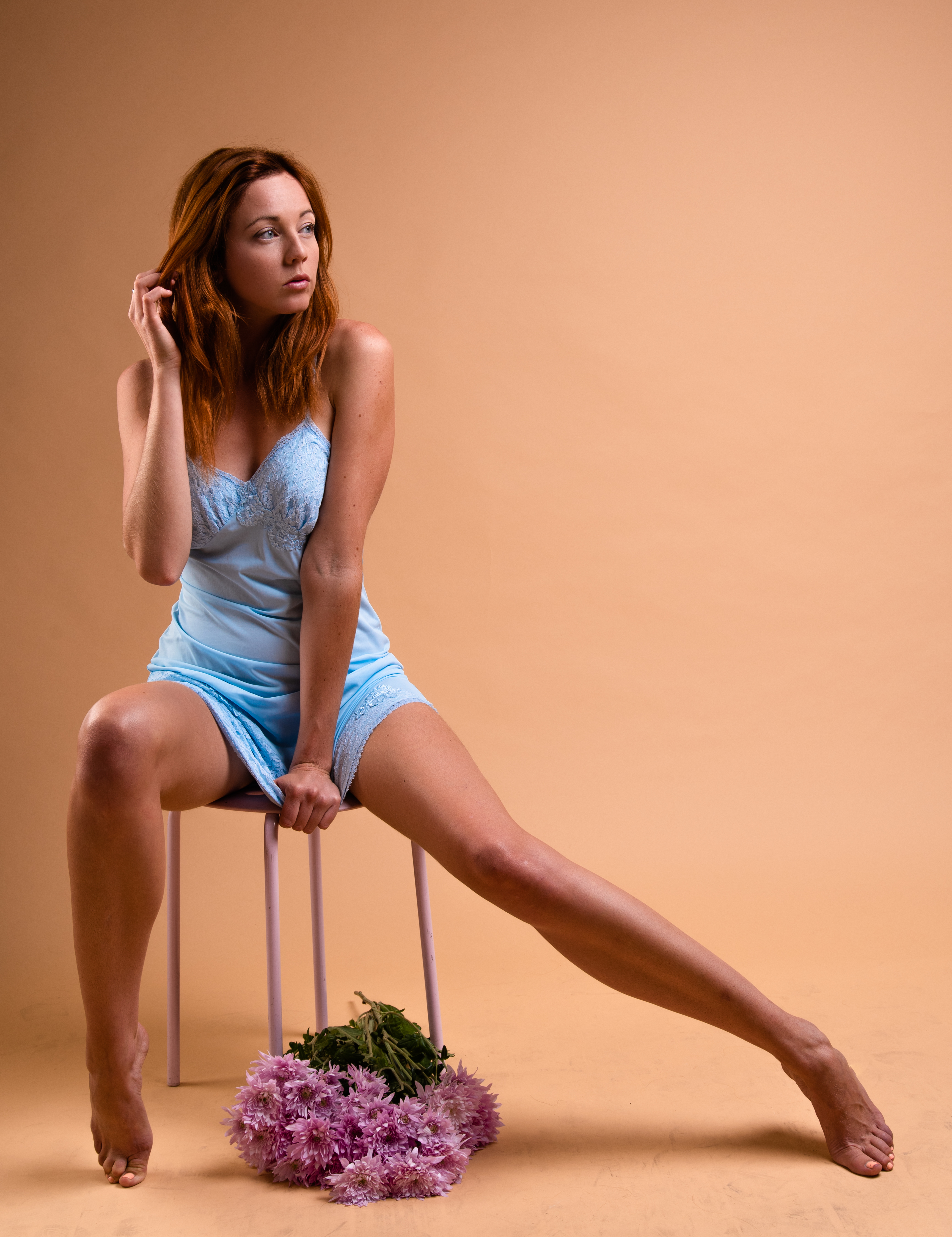
My practice developed. I hired studios, booked models, attended workshops. I learned posing mostly from the models themselves, and more about lighting from every shoot – how to use a beauty dish, umbrella, softbox, and how to make the most of window light. As the gear expanded so did my knowledge. I’d moved a long way from the days of the halogen lamp and the oven tray wrapped in foil.
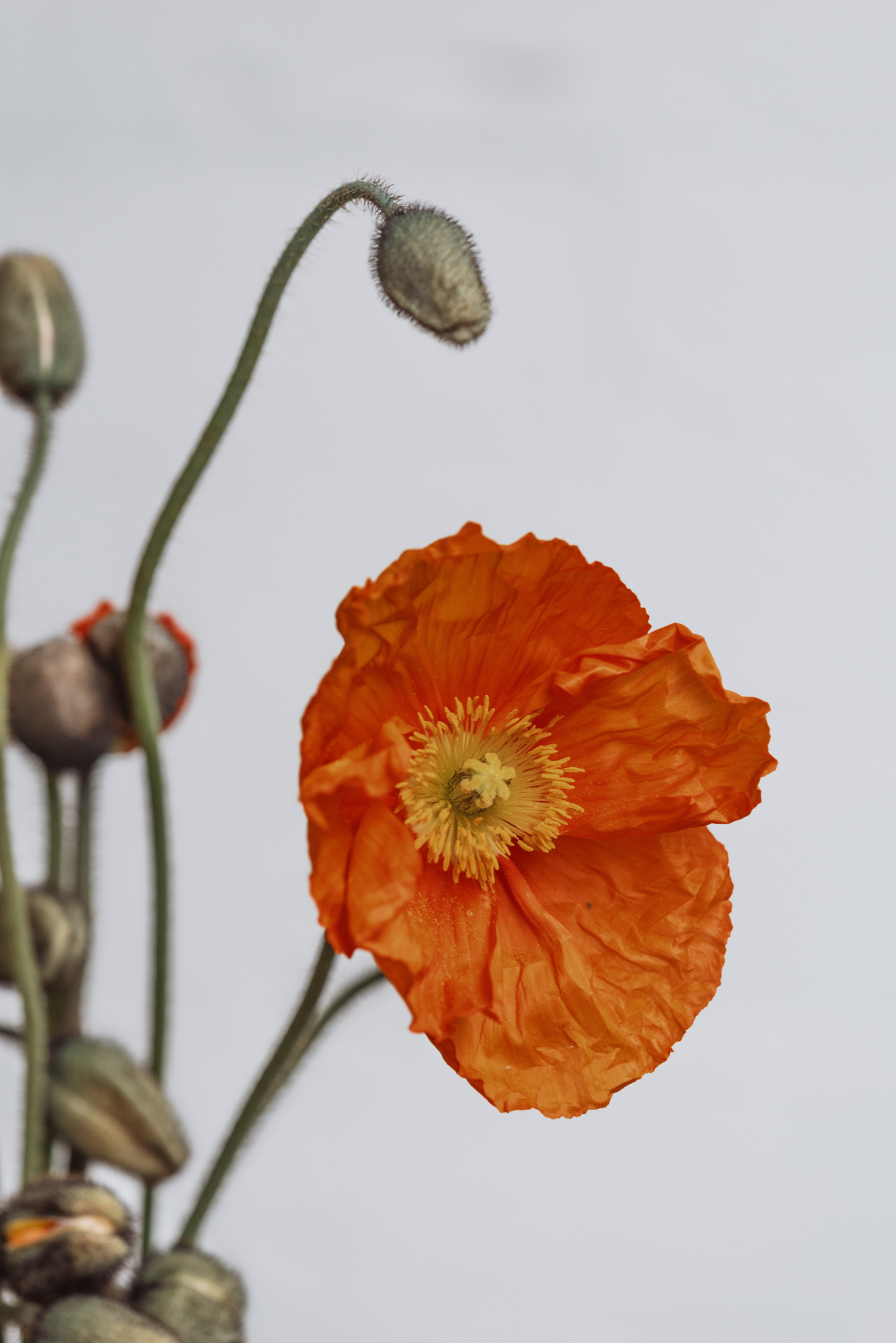
One house we lived in had a white brick wall to use as a backdrop, two storeys high and east-facing. It was a space filled with light, and the tulips, hydrangeas, sunflowers, and poppies looked luminous against it.
Then life got in the way …
Eventually, another move, another house. I had a ‘studio’ in this new house, and I painted the walls a neutral colour to use as a backdrop. I kept out some of the lighting gear, thinking I’d get around to using it. But two years passed with only a handful of photographs, none of which excited me. They were just the same, but worse technically. I set up the lights, but couldn’t create anything new. Photography no longer satisfied me in the way it had and I began to wonder if I had anything left to say.
I thought the issue might have been one of space and explored the idea of building a studio in the backyard. But in a moment of clarity, I realised that I hadn’t learnt to use the light in this new house. Shortly after, at a photography workshop in Ballarat, Kris, the facilitator, spoke about recognising your own style – how good it was when someone recognises one of your images as yours because it has a certain style. That struck me and the two ideas became a spark.
I looked around the house again – so many windows, so much light. Different walls, each with its own character/colour/shadows. I realised that what I’d thought was sameness was actually my style, something I’d been building since 2007.
I felt excited again. I made so many different choices, and remembered what a photography teacher had once told me: photography is problem-solving. Given all the problems I was solving (how to hold the reflector in just the right position, how much to open or close the shutters, what to hold the flower with, how close or far away from the background to put the flower), I felt the truth of it. I also knew that the solutions could be simple: a halogen lamp and an oven tray wrapped in foil, a window and a square of black card, a green wall and shutters to shape the light.
And so each morning I reach for my camera and some flowers, and go in search of the light. I fall into a rhythm – one which absorbs and excites me. I feels my style re-emerging, and with it, the outline of a new self.
An early image (circa 2007)
The white wall as backdrop
Street portraits
Samyrah – outside H&MBrabh – first street portrait (at the lights on King St)George – Bourke St mall
When she started teaching, she dressed more like an English teacher, although preferred to call herself a Drama teacher. She taught both, but she wanted the stereotype of a Drama teacher to suit her more – creative, exploratory, suggesting invention and movement.
Later, as a PhD student, she carried her lunch into the staff lounge and walked past the big table where the academics sat. She sat instead in the corner, with her sandwich and a journal article or two. She enjoyed the thinking and the stretch of ideas, but she couldn’t yet picture herself wearing the identity that the big table represented.
In time she did, and the academic identity settled more deeply than she expected. In fact, it was the hardest one to let go of. Not because it had ever been easy – it was never that – but because it felt true. It matched her need to make sense of things, to learn, to question, to seek alternatives. And it gave her a title that needed no explanation.
When that identity fell away, she felt a bit lost. Eventually, she became a Senior Consultant Associate. When she was asked what she did, people would invariably say, “What does that entail?” and in the 18 months she was in the role, she never got to the point of being able to easily explain it. So instead, she often told people she was a ‘researcher’ – an identity more closely aligned with ‘academic’.
She had tried retirement before but hadn’t found an identity within it. This time though, with more certainty that it would stick, she knew she needed to work out what her new identity might be.
The question that pushed her in this direction was: “How did you fill your day today?”. She disliked the language of that question, the sense that life without paid work was only marking time, of ‘filling’ time. It’s not a question people asked of those who head off to jobs every morning. And so she bristled at it.
She wasn’t retired from living, or from creating, or from learning. Her life, even her retired life, was made up of more than ‘filling’ time.
And so each morning, she took photos. An anthurium. A sunflower on a black tile. Flannel flowers in a brown vase. Each afternoon she sat at her desk and wrote blog posts, exploring a different style in a different voice to see how it felt.
When she saw the images and words on the screen, she felt a flicker of something that she wasn’t quite ready to face.
But the question lingered: “How did you fill your day today?”. She had no tidy answer yet, but she could feel that she was reaching for something. She’s crafting her ideas into words and images, taking notice, taking her time.
She’s trying on a new identity, one that’s not dependent on a role, or a job, or an income. It’s an identity dependent on what she creates.
She’s not sure she can even say it out loud yet … so she whispers it to herself, to see if it fits.
…
Not yet … but it’s early days and she knows there’s no rush.
She sets up carefully: a sheet of black card for the backdrop, the shutters angled to shape the light, the plamp ready to hold the anthurium steady or pull leaves out of the frame. She likes to get the shot right in camera so thinks about the composition, what’s in and what’s out, where the focus hits, how the light falls.
And yet, in this meticulously constructed scene, the unexpected happens. A petal drops. A cloud crosses the sun. The reflector topples just as the light was perfect.
She clicks anyway. The flower leans awkwardly, the shadows fall in unexpected ways, the vase looks crooked. The image isn’t like the one she imagined, but it carries something she hadn’t planned for.
Photography, she remembers, isn’t only about getting it right in camera. It’s also about letting go – allowing the scene, the light, and the unexpected to have a say … the blur, the shadow, the crooked vase.
When she clicks the shutter again, she does so with curiosity. The image is imperfect, but it has something the more carefully crafted ones don’t – a sliver of truth.
A gentle reminder that sometimes more interesting things happen when you let go.
And then she opens the files on her computer. Out of focus, shadowy, crooked. She sighs. All very well to wax lyrical about imperfection, she thinks, but she still doesn’t like them.
There’s a cat on her windowsill. The black one from next door, red bandana tied rakishly around its neck, a burst of insouciance.
He watches her, looking like he knows things she doesn’t.
She watches him back then lifts the camera and looks away.
In photography, negative space is the area around the subject, the quiet, unclaimed part of the frame. She looks there instead of at the cat. At the branches giving him an absurd hat. At the fence palings rearing from his head. At the shadows, menacing, behind him. She makes a choice about where to put her attention.
Then is drawn back to her phone by the vibration, and spins through war, famine, scandal, disaster. She scrolls, for far too long, then finally looks away.
She looks away and in doing so notices the tiny bits of life that belong only here, at this moment in time. The sunlight sliding through the shutters like it has somewhere else to be, the Vegemite-coated knife balancing on the sink as if auditioning for the circus, the leaf skittering erractically down the path to come to rest on the mat at the back door, the cat still watching from the windowsill.
She lifts her camera again, capturing it mid-stretch, and realises – again – that the art of looking away is also the art of looking at.
She photographs because she wants to hold still what is fleeting – an angle, a pose, an age, a smile, a moment in time – before it dissolves, fades, evaporates into reality.
But what she doesn’t photograph matters too.
She didn’t photograph the sky turning red from a hundred bushfires, or the water lapping at the laundry door. She didn’t photograph the washing line, snaking down the backyard, heavy under the weight of the weekly wash, or the heat from the wood stove in the kitchen. She didn’t photograph the hospital bracelet crumpled in the bottom of the bag, or the small fist clutching a handful of her mother’s hair.
She didn’t photograph the look exchanged before the first word of bad news, or the sigh that followed.
She didn’t photograph the relief in the hospital corridor after the surgeon said it went well, the ordinary dinners that kept them alive through ‘that’ time, the thousand mornings where nothing “happened” except that she woke up, or her fumbling attempts at dancing that looked more like jelly caught on a string.
Sometimes she wants proof that it really happened the way she thinks it did. That the sky really was pea soup green, that the drummer really did smile at her.
Maybe it’s better this way. No evidence, no proof. A series of memories, more absurd and exaggerated each time she recalls them – never sure which details are real and which are imagined.
I’ve always been fascinated by the use of ‘shop lifting’ for ‘stealing’. I wonder how that came about – and why? Who decided that we’d cushion the harshness, the directness, the in-your-faceness of ‘thief’ with the much gentler ‘shop lifter’?
I guess I could look it up if I was so inclined.
Also, who decided they’d term the injuring and killing of civilians ‘collateral damage’ as if people were bits of furniture that got in the way of bombs and bullets.
Or ‘friendly fire’ rather than saying you killed people on your own side?
And do women still ‘powder their noses’ when they need to pee? And do parents still talk about number ones and twos with their kids?
Don’t get me wrong, euphemisms serve a purpose. Sometimes saying the thing itself is too blunt, too harsh, too direct. We’re much more inclined to say that someone has ‘passed away’ than they’ve ‘died’. Or as one grieving wife told her daughter the other day “Daddy has gone on a work trip with Jesus”. There’s a finality to the blunter word that is softened by other ways of phrasing it.
When we rename harsh realities euphemistically, they may not hurt so much, they may make the reality more palatable. They may make it easier to convey things that we’re otherwise embarrassed or uncomfortable to convey.
For instance, I was sacked this week. Not for any wrongdoing or poor performance – purely as an economic decision.
Since learning of said sacking, I’ve been struggling with how to soften the message when I tell other people, of how to not sound bitter (I’m honestly not at all bitter), of how to communicate that it wasn’t because I was bad at my job.
And so I’ve been turning to euphemisms – softer words that cushion the harsh reality of having been ‘given my notice’, ‘let go’, ‘restructured out’, ‘transitioned’, ‘invited to pursue other opportunities’.
So here I am, ‘hanging up my hat’, ‘calling it a day’, ‘moving into a new season’, ‘starting a new chapter’, or if you prefer, ‘entering into a period of rewirement’ (a fantastically euphemistic word if ever I heard one).
Or another way to look at it is, that at this very early stage of transition from work to whatever comes after it, I’m simply ‘between adventures’.








 Musings from the cold